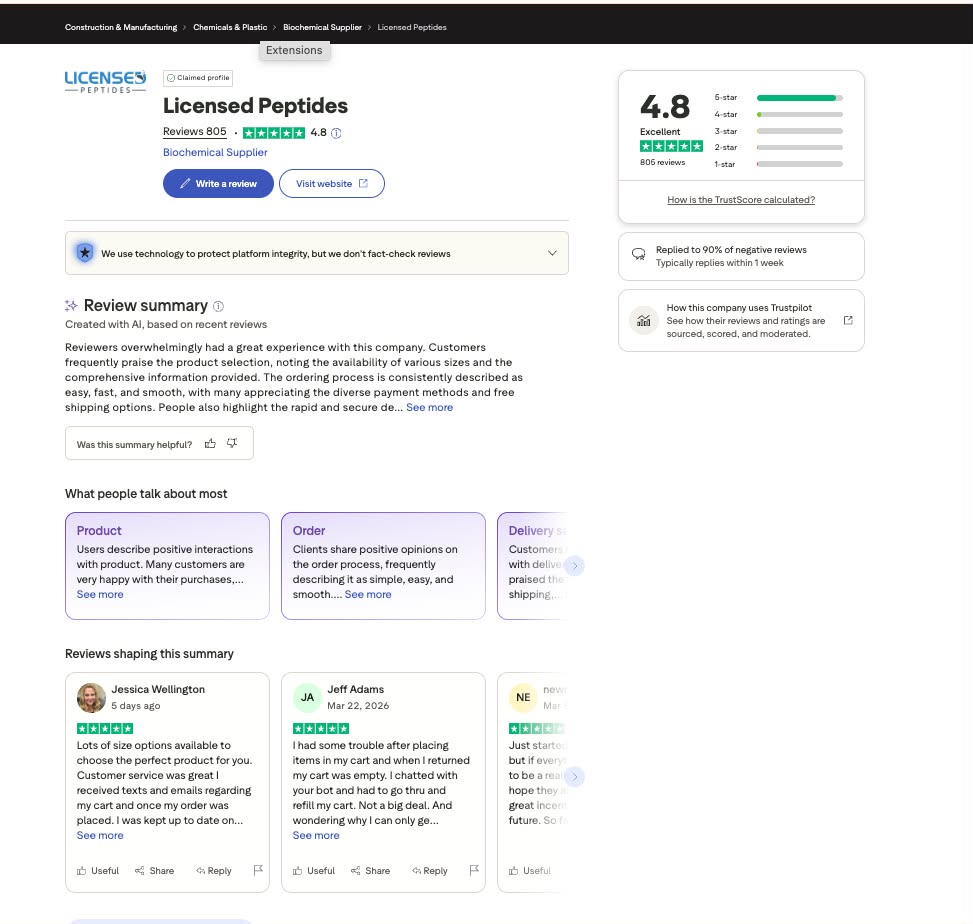
What happened to our Trustpilot reviews
Above is a snapshot of our total Trustpilot review count as it appeared in January 2026, shortly before our business profile was removed from the platform.
For years, Licensed Peptides earned its reputation through consistent customer service and genuine customer experiences. Our reviews were not solicited in bulk or manufactured through marketing campaigns—they were shared voluntarily by real customers over time, reflecting their firsthand experiences with our company.
In early 2026, Trustpilot removed our business profile. Following multiple attempts to seek clarification, we were informed that the decision was not based on the legality of our operations, but rather on Trustpilot’s internal Code of Ethics and what they described as a lack of alignment with their platform standards.
According to Trustpilot, our business was classified under the sale of “unregulated drugs/medications,” and that classification alone was considered sufficient grounds for removal. No specific law was cited, no customer harm was identified, and no concerns were raised regarding the authenticity of our reviews.
Importantly, the issue was never presented as one of fraudulent, misleading, or manipulated feedback. Instead, we were told that our industry no longer fit within Trustpilot’s evolving ethical framework.
We believe that distinction is significant. When platforms shift from objective measures—such as authenticity, fraud prevention, and customer protection—to subjective interpretations of ethics and acceptability, lawful businesses can be excluded without meaningful transparency or recourse.
Businesses operating outside traditional pharmaceutical models are often among the first to encounter these challenges. As consumers seek alternative approaches focused on education, research, and personal understanding rather than long-term symptom management, access to visibility and open discussion can become increasingly vulnerable. In such environments, policies and ethical standards may function less as safeguards and more as mechanisms that limit exposure and conversation.
Whether the result is intentional or simply a byproduct of platform governance, the impact remains the same: the voices of thousands of legitimate customers disappeared overnight. A public record built over many years was removed—not because it lacked authenticity, but because it no longer aligned with a centralized platform’s determination of what should remain visible.