
99%+ Purity
Guaranteed per batch

4.9 847 verified reviews

4.9 847 verified reviews
99%+ HPLC Purity —
Independently verified by accredited US laboratory
Endotoxin-Screened —
LAL tested, LPS-free, endotoxin report available
GMP-Certified Manufacturing —
USA facility, ISO 9001:2015
Lyophilized for Stability —
Shipped cold-packed, intact for reconstitution
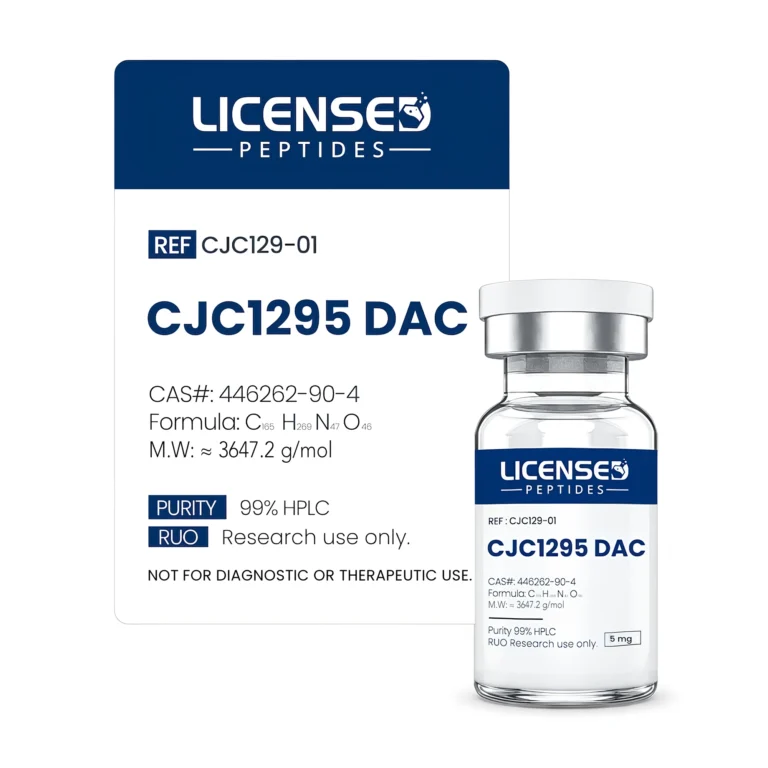
CJC-1295 DAC manufactured in GMP-certified U.S. facilities and independently analyzed for molecular identity, purity, sterility, and consistency through a 6-point verification process. Certificates of analysis (COA) are available for every batch we supply.
Important Notice – We supply CJC-1295 DAC peptide exclusively for research. It’s not approved for human or veterinary use. Any discussion concerning the biological activity of CJC-1295 refers to preclinical and in vitro studies only.
| Form supplied | Lyophilized powder |
|---|---|
| Purity | >99%+ HPLC-Verified |
| Application | Research use only |
Interest in the molecule is a half-life problem. Native GHRH(1-29) is cleared within minutes, which makes it awkward as a probe of the GHRH-receptor axis. Bioconjugation to albumin was introduced specifically to extend that window, and the 2005 Endocrinology report that described the approach identified CJC-1295 as a long-lasting GRF analogue acting at the anterior pituitary in rats.1
Mechanistic work is done at the pituitary GHRH receptor: the analogue is applied to anterior pituitary preparations and downstream growth hormone release is measured, then followed in whole-animal models over time to read out the extended exposure the albumin conjugation produces.1,2
Jetté and colleagues reported in 2005 that hGRF(1-29)-albumin bioconjugates activate the GRF receptor on the anterior pituitary in rats, and identified CJC-1295 as the long-lasting analogue from that series.1
A 2006 study in American Journal of Physiology-Endocrinology and Metabolism reported that once-daily administration of CJC-1295 normalized growth in the GHRH-knockout mouse.2
The material is supplied as a lyophilized (freeze-dried) powder. Freeze-drying is used for peptides because removing water suppresses the hydrolysis and aggregation routes that dominate degradation in solution, and the resulting amorphous solid is far more stable on storage than the corresponding liquid.3 Reported degradation routes for peptides in the solid state include deamidation of asparagine and glutamine residues, oxidation of methionine and tryptophan, and physical aggregation, all of which are accelerated by residual moisture, elevated temperature and repeated freeze-thaw cycling.4 Sealed vials are therefore held at −20 °C, protected from light, and reconstituted material is kept cold and used within a short working window. For laboratory research use only.
For laboratory research use only. Products on this website are intended solely for in-vitro research. They are not medicines, have not been evaluated by the FDA, and are not intended to diagnose, treat, cure, or prevent any disease. Any administration to humans or animals is strictly prohibited.


Proper storage is essential for preserving peptide integrity throughout laboratory investigations. Licensed Peptides supplies CJC-1295 in a lyophilized (freeze-dried) form to maximize stability during shipping and long-term storage.
Store unopened vials in a cool, dry location away from direct sunlight and excessive humidity.
For archival storage, many laboratories utilize temperatures approaching -80°C (-112°F).
For laboratory research use only. Not for human or veterinary use.

Here at Licensed Peptides, we supply CJC-1295 DAC for research use only. We use a 6-point verification process to ensure you receive a reliable CJC-1295 peptide that you can use for both short and long-term studies.
We understand the importance of purity and sterility in research compounds; that’s why we manufacture our CJC-1295 under strict quality standards in GMP-certified facilities, after which independent, accredited laboratories verify its quality.
CJC-1295 is a modified analog of human growth hormone-releasing factor 1-29, or hGRF(1-29) (1-29 means it’s a chain of 29 amino acids). Researchers developed it to retain activity at the GHRH receptor while remaining detectable in circulation longer than unmodified hGRF(1-29).¹
CJC-1295 is among the most studied peptides because of its ability to stay in circulation longer. Researchers investigate it to better understand how modifications in structure influence the stability of peptides and endocrine signaling. Current areas of research include:
The presence of Drug Affinity Complex (DAC) has made CJC-1295 valuable, particularly in studies investigating how different ways of synthesizing peptides can affect circulation time and interaction with different receptors.
Albumin is the most abundant protein in blood plasma, and one of its primary roles is to transport molecules throughout the body while protecting them from rapid degradation.2 Researchers continue to investigate how DAC enables CJC-1295 to bind to circulating albumin, thereby reducing the rate at which it’s removed from circulation.
This is one of the common areas of study for CJC-1295. One original preclinical study found that albumin-conjugated hGRF analogs retained activity at the GRF receptor in rat models.1 This study set the precedent and made the CJC-1295 peptide useful for examining how structural modifications affect the activity of growth hormone receptors.
CJC-1295 provides researchers with a model for studying how amino acid substitutions and albumin conjugation affect peptide absorption, distribution, persistence, and exposure to receptors. The foundational preclinical work focused on molecular design and albumin bioconjugation, while later studies investigated its extended pharmacokinetic and endocrine signaling profile.1,2,4,5 Researchers continue to investigate these areas of study.
| Characteristic | CJC-1295 With DAC | MOD GRF 1-29 (CJC-1295 With No DAC) |
| Peptide Type | Modified hGRF(1-29) analog | Modified hGRF(1-29) analog |
| Drug Affinity Complex (DAC) | Present | Absent |
| Albumin Conjugation | Forms an in vivo covalent albumin bioconjugate1 | No DAC-mediated albumin conjugation |
| Plasma Persistence | Prolonged in published studies1,4 | Shorter-acting by design |
| Main Research Interest | Albumin conjugation, prolonged pharmacokinetics and sustained GHRH-receptor signaling | Short-duration GHRH-receptor activation and peptide signaling |
| Scientific Naming | CJC-1295/DAC-GRF | MOD GRF 1-29 |
We supply CJC-1295 DAC peptide exclusively for research. It’s not approved for human or veterinary use. Any discussion concerning the biological activity of CJC-1295 refers to preclinical and in vitro studies only.
1. Jetté L, Léger R, Thibaudeau K, et al. Human growth hormone-releasing factor (hGRF) 1–29-albumin bioconjugates activate the GRF receptor on the anterior pituitary in rats: identification of CJC-1295 as a long-lasting GRF analog. Endocrinology. 2005;146(7):3052-3058. doi:10.1210/en.2004-1286
2. Belinskaia DA, Voronina PA, Shmurak VI, Jenkins RO, Goncharov NV. Serum albumin in health and disease: esterase, antioxidant, transporting and signaling properties. Int J Mol Sci. 2021;22(19):10318. doi:10.3390/ijms221910318
3. Mayo KE, Godfrey PA, Suhr ST, Kulik DJ, Rahal JO. Growth hormone-releasing hormone: synthesis and signaling. Recent Prog Horm Res. 1995;50:35-73. doi:10.1016/b978-0-12-571150-0.50007-x
4. Teichman SL, Neale A, Lawrence B, Gagnon C, Castaigne JP, Frohman LA. Prolonged stimulation of growth hormone (GH) and insulin-like growth factor I secretion by CJC-1295, a long-acting analog of GH-releasing hormone, in healthy adults. J Clin Endocrinol Metab. 2006;91(3):799-805. doi:10.1210/jc.2005-1536
5. Ionescu M, Frohman LA. Pulsatile secretion of growth hormone (GH) persists during continuous stimulation by CJC-1295, a long-acting GH-releasing hormone analog. J Clin Endocrinol Metab. 2006;91(12):4792-4797. doi:10.1210/jc.2006-1702
For laboratory research use only. Not for human or veterinary use.
At Licensed Peptides™, we focus on quality at every stage of our manufacturing and verification process. Every batch of CJC-1295 follows a strict, pharma-grade workflow, ensuring the peptides you purchase are stable and pure, from synthesis to delivery.
We synthesize all our CJC-1295 DAC peptides in sterile, controlled environments to reduce the risk of contamination. This ensures consistency across every single batch.
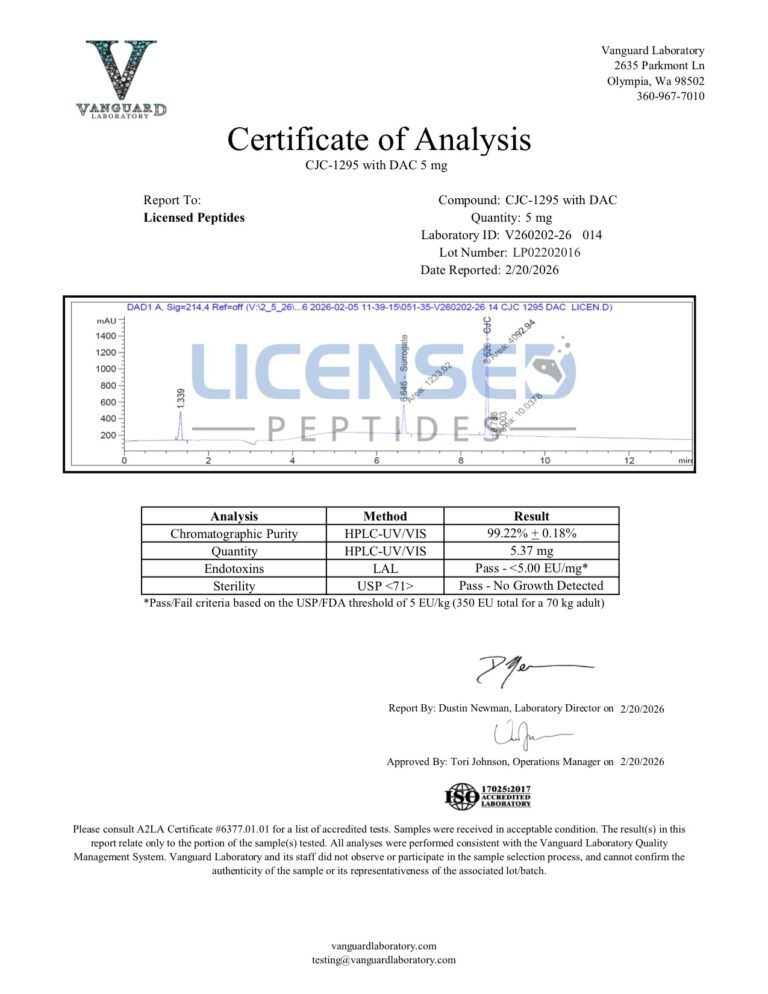
In order to verify purity with precision, we use advanced High-Performance Liquid Chromatography (HPLC) analysis. This means your CJC-1295 peptide is free from unwanted chemicals and impurities.
We use mass spectrometry to confirm molecular identity. We also test each batch for endotoxins, including lipopolysaccharides (LPS), using Limulus Amebocyte Lysate (LAL). Each batch also undergoes HPLC purity analysis.
We supply CJC-1295 with verified endotoxin reports. Low endotoxin levels are important in sensitive receptor-signaling studies where inflammatory contaminants may influence the outcome of the experiment.
Our manufacturing process begins with rigorously tested amino acids and validated reagents. This procedure protects the molecular integrity of the peptide throughout its synthesis.
Freeze-dried CJC-1295 DAC is more stable. This means that it’s less likely to degrade during experimentation, because its structural integrity is intact. It also ensures it’s reliable for lab work.
We seal our CJC-1295 peptide in nitrogen to minimize exposure to oxygen and moisture. This preserves its integrity while you’re transporting and storing it.
From peptide synthesis to final fulfillment, we meet the expectations of researchers who need dependable sourcing to ensure they create reproducible studies.
Our responsive U.S.-based team understands the needs of researchers and is available to assist you.
Call us at +1 (855) 322-2214 or email [email protected] to speak with our team.
For laboratory research use only. Not for human or veterinary use.
Research schedules often depend on reliable fulfillment. That’s why Licensed Peptides prioritizes rapid processing and secure shipping throughout the United States.
Same Day Shipping – Orders placed before our daily dispatch cutoff are shipped the same business day whenever products are in stock.
Fast Domestic Delivery – We partner with trusted domestic carriers to provide reliable delivery throughout the United States.
Cold Storage Before Dispatch – Our CJC-1295 remains under controlled storage conditions prior to shipment to help preserve its stability.
Protective Packaging – We package all orders securely to minimize exposure to moisture, temperature fluctuations, and physical damage during transit.
Real-Time Tracking – Tracking information is provided once your order of CJC with DAC ships, allowing you to monitor delivery from dispatch through arrival.
For laboratory research use only. Not for human or veterinary use.
| pack | 1 pack, 3 pack, 5 pack, 10 pack |
|---|
CJC-1295 DAC manufactured in GMP-certified U.S. facilities and independently analyzed for molecular identity, purity, sterility, and consistency through a 6-point verification process. Certificates of analysis (COA) are available for every batch we supply.
Important Notice – We supply CJC-1295 DAC peptide exclusively for research. It’s not approved for human or veterinary use. Any discussion concerning the biological activity of CJC-1295 refers to preclinical and in vitro studies only.
| Form supplied | Lyophilized powder |
|---|---|
| Purity | >99%+ HPLC-Verified |
| Application | Research use only |
Interest in the molecule is a half-life problem. Native GHRH(1-29) is cleared within minutes, which makes it awkward as a probe of the GHRH-receptor axis. Bioconjugation to albumin was introduced specifically to extend that window, and the 2005 Endocrinology report that described the approach identified CJC-1295 as a long-lasting GRF analogue acting at the anterior pituitary in rats.1
Mechanistic work is done at the pituitary GHRH receptor: the analogue is applied to anterior pituitary preparations and downstream growth hormone release is measured, then followed in whole-animal models over time to read out the extended exposure the albumin conjugation produces.1,2
Jetté and colleagues reported in 2005 that hGRF(1-29)-albumin bioconjugates activate the GRF receptor on the anterior pituitary in rats, and identified CJC-1295 as the long-lasting analogue from that series.1
A 2006 study in American Journal of Physiology-Endocrinology and Metabolism reported that once-daily administration of CJC-1295 normalized growth in the GHRH-knockout mouse.2
The material is supplied as a lyophilized (freeze-dried) powder. Freeze-drying is used for peptides because removing water suppresses the hydrolysis and aggregation routes that dominate degradation in solution, and the resulting amorphous solid is far more stable on storage than the corresponding liquid.3 Reported degradation routes for peptides in the solid state include deamidation of asparagine and glutamine residues, oxidation of methionine and tryptophan, and physical aggregation, all of which are accelerated by residual moisture, elevated temperature and repeated freeze-thaw cycling.4 Sealed vials are therefore held at −20 °C, protected from light, and reconstituted material is kept cold and used within a short working window. For laboratory research use only.
For laboratory research use only. Products on this website are intended solely for in-vitro research. They are not medicines, have not been evaluated by the FDA, and are not intended to diagnose, treat, cure, or prevent any disease. Any administration to humans or animals is strictly prohibited.
Proper storage is essential for preserving peptide integrity throughout laboratory investigations. Licensed Peptides supplies CJC-1295 in a lyophilized (freeze-dried) form to maximize stability during shipping and long-term storage.
Store unopened vials in a cool, dry location away from direct sunlight and excessive humidity.
For archival storage, many laboratories utilize temperatures approaching -80°C (-112°F).
For laboratory research use only. Not for human or veterinary use.
Here at Licensed Peptides, we supply CJC-1295 DAC for research use only. We use a 6-point verification process to ensure you receive a reliable CJC-1295 peptide that you can use for both short and long-term studies.
We understand the importance of purity and sterility in research compounds; that’s why we manufacture our CJC-1295 under strict quality standards in GMP-certified facilities, after which independent, accredited laboratories verify its quality.
CJC-1295 is a modified analog of human growth hormone-releasing factor 1-29, or hGRF(1-29) (1-29 means it’s a chain of 29 amino acids). Researchers developed it to retain activity at the GHRH receptor while remaining detectable in circulation longer than unmodified hGRF(1-29).¹
CJC-1295 is among the most studied peptides because of its ability to stay in circulation longer. Researchers investigate it to better understand how modifications in structure influence the stability of peptides and endocrine signaling. Current areas of research include:
The presence of Drug Affinity Complex (DAC) has made CJC-1295 valuable, particularly in studies investigating how different ways of synthesizing peptides can affect circulation time and interaction with different receptors.
Albumin is the most abundant protein in blood plasma, and one of its primary roles is to transport molecules throughout the body while protecting them from rapid degradation.2 Researchers continue to investigate how DAC enables CJC-1295 to bind to circulating albumin, thereby reducing the rate at which it’s removed from circulation.
This is one of the common areas of study for CJC-1295. One original preclinical study found that albumin-conjugated hGRF analogs retained activity at the GRF receptor in rat models.1 This study set the precedent and made the CJC-1295 peptide useful for examining how structural modifications affect the activity of growth hormone receptors.
CJC-1295 provides researchers with a model for studying how amino acid substitutions and albumin conjugation affect peptide absorption, distribution, persistence, and exposure to receptors. The foundational preclinical work focused on molecular design and albumin bioconjugation, while later studies investigated its extended pharmacokinetic and endocrine signaling profile.1,2,4,5 Researchers continue to investigate these areas of study.
| Characteristic | CJC-1295 With DAC | MOD GRF 1-29 (CJC-1295 With No DAC) |
| Peptide Type | Modified hGRF(1-29) analog | Modified hGRF(1-29) analog |
| Drug Affinity Complex (DAC) | Present | Absent |
| Albumin Conjugation | Forms an in vivo covalent albumin bioconjugate1 | No DAC-mediated albumin conjugation |
| Plasma Persistence | Prolonged in published studies1,4 | Shorter-acting by design |
| Main Research Interest | Albumin conjugation, prolonged pharmacokinetics and sustained GHRH-receptor signaling | Short-duration GHRH-receptor activation and peptide signaling |
| Scientific Naming | CJC-1295/DAC-GRF | MOD GRF 1-29 |
We supply CJC-1295 DAC peptide exclusively for research. It’s not approved for human or veterinary use. Any discussion concerning the biological activity of CJC-1295 refers to preclinical and in vitro studies only.
1. Jetté L, Léger R, Thibaudeau K, et al. Human growth hormone-releasing factor (hGRF) 1–29-albumin bioconjugates activate the GRF receptor on the anterior pituitary in rats: identification of CJC-1295 as a long-lasting GRF analog. Endocrinology. 2005;146(7):3052-3058. doi:10.1210/en.2004-1286
2. Belinskaia DA, Voronina PA, Shmurak VI, Jenkins RO, Goncharov NV. Serum albumin in health and disease: esterase, antioxidant, transporting and signaling properties. Int J Mol Sci. 2021;22(19):10318. doi:10.3390/ijms221910318
3. Mayo KE, Godfrey PA, Suhr ST, Kulik DJ, Rahal JO. Growth hormone-releasing hormone: synthesis and signaling. Recent Prog Horm Res. 1995;50:35-73. doi:10.1016/b978-0-12-571150-0.50007-x
4. Teichman SL, Neale A, Lawrence B, Gagnon C, Castaigne JP, Frohman LA. Prolonged stimulation of growth hormone (GH) and insulin-like growth factor I secretion by CJC-1295, a long-acting analog of GH-releasing hormone, in healthy adults. J Clin Endocrinol Metab. 2006;91(3):799-805. doi:10.1210/jc.2005-1536
5. Ionescu M, Frohman LA. Pulsatile secretion of growth hormone (GH) persists during continuous stimulation by CJC-1295, a long-acting GH-releasing hormone analog. J Clin Endocrinol Metab. 2006;91(12):4792-4797. doi:10.1210/jc.2006-1702
For laboratory research use only. Not for human or veterinary use.
At Licensed Peptides™, we focus on quality at every stage of our manufacturing and verification process. Every batch of CJC-1295 follows a strict, pharma-grade workflow, ensuring the peptides you purchase are stable and pure, from synthesis to delivery.
We synthesize all our CJC-1295 DAC peptides in sterile, controlled environments to reduce the risk of contamination. This ensures consistency across every single batch.
In order to verify purity with precision, we use advanced High-Performance Liquid Chromatography (HPLC) analysis. This means your CJC-1295 peptide is free from unwanted chemicals and impurities.
We use mass spectrometry to confirm molecular identity. We also test each batch for endotoxins, including lipopolysaccharides (LPS), using Limulus Amebocyte Lysate (LAL). Each batch also undergoes HPLC purity analysis.
We supply CJC-1295 with verified endotoxin reports. Low endotoxin levels are important in sensitive receptor-signaling studies where inflammatory contaminants may influence the outcome of the experiment.
Our manufacturing process begins with rigorously tested amino acids and validated reagents. This procedure protects the molecular integrity of the peptide throughout its synthesis.
Freeze-dried CJC-1295 DAC is more stable. This means that it’s less likely to degrade during experimentation, because its structural integrity is intact. It also ensures it’s reliable for lab work.
We seal our CJC-1295 peptide in nitrogen to minimize exposure to oxygen and moisture. This preserves its integrity while you’re transporting and storing it.
From peptide synthesis to final fulfillment, we meet the expectations of researchers who need dependable sourcing to ensure they create reproducible studies.
Our responsive U.S.-based team understands the needs of researchers and is available to assist you.
Call us at +1 (855) 322-2214 or email [email protected] to speak with our team.
For laboratory research use only. Not for human or veterinary use.
Research schedules often depend on reliable fulfillment. That’s why Licensed Peptides prioritizes rapid processing and secure shipping throughout the United States.
Same Day Shipping – Orders placed before our daily dispatch cutoff are shipped the same business day whenever products are in stock.
Fast Domestic Delivery – We partner with trusted domestic carriers to provide reliable delivery throughout the United States.
Cold Storage Before Dispatch – Our CJC-1295 remains under controlled storage conditions prior to shipment to help preserve its stability.
Protective Packaging – We package all orders securely to minimize exposure to moisture, temperature fluctuations, and physical damage during transit.
Real-Time Tracking – Tracking information is provided once your order of CJC with DAC ships, allowing you to monitor delivery from dispatch through arrival.
For laboratory research use only. Not for human or veterinary use.
| pack | 1 pack, 3 pack, 5 pack, 10 pack |
|---|
Guaranteed per batch

Independent lab verified

Vanguard Laboratory · ISO/IEC 17025

USA-manufactured

Free FedEx on $200+
Every batch is independently tested before it ships. Full documentation available for every product.
 99%+ — Passes ≥99%
Confirmed — 1419.6 m/z
<1.0 EU/mg — LPS-Free
No growth detected
White lyophilized powder
All 15 residues confirmed
±0.2% — Within spec
Vanguard Laboratory · ISO/IEC 17025 · A2LA #6377.01.01
GMP / ISO 9001:2015
2026
Verified
99%+ — Passes ≥99%
Confirmed — 1419.6 m/z
<1.0 EU/mg — LPS-Free
No growth detected
White lyophilized powder
All 15 residues confirmed
±0.2% — Within spec
Vanguard Laboratory · ISO/IEC 17025 · A2LA #6377.01.01
GMP / ISO 9001:2015
2026
Verified
 Download Full COA / HPLC Report (PDF)
Verify With Vanguard Laboratory
Download Full COA / HPLC Report (PDF)
Verify With Vanguard Laboratory

Not all peptide vendors hold themselves to the same verification standards.
| Verification Standard | Licensed Peptides | Generic Vendors |
|---|---|---|
| HPLC Purity Analysis |  99%+ Every Batch 99%+ Every Batch |
 Often Not Disclosed Often Not Disclosed |
| Mass Spectrometry Identity | Sequence Confirmed |
Rarely Available |
| Endotoxin Screening (LAL) | Every Product |
Industry Exception |
| GMP-Certified USA Manufacture | ISO 9001:2015 |
Often Overseas |
| COA Published & Downloadable | Every Lot |
Inconsistent |
| Same-Day USA Fulfillment | Before 4PM PST |
3-10 Day Lead Time |
CJC-1295 is a synthetic Growth Hormone-Releasing Hormone (GHRH) analog developed for laboratory research. Researchers continue studying it in studies about receptor pharmacology, peptide engineering, and pharmacokinetics.
DAC stands for Drug Affinity Complex. This is a molecular modification designed to prolong its circulation by enabling covalent conjugation with serum albumin.
CJC-1295 is a synthetic peptide derived from Growth Hormone-Releasing Hormone (GHRH). It’s made to mimic endogenous GHRH (which signals the body to release Growth Hormone), and also to improve its stability and resistance to degradation.
DAC stands for Drug Affinity Complex, which is a proprietary molecular modification that was developed to help peptides remain in circulation for longer during research. Better stability means researchers can study the effects of CJC-1295 within the body for longer periods of time.
Interested in a version with no DAC? Our verified CJC-1295 No DAC (also called ModGRF 1-29) is made with the same attention to quality and research-grade standards.
For researchers exploring related GHRH analogs or growth hormone secretagogues, our collection also includes compounds such as Ipamorelin, Sermorelin, and Tesamorelin, as well as peptide blends like CJC-1295 No DAC + Ipamorelin.
CJC-1295 contains the Drug Affinity Complex (DAC), whereas MOD GRF 1-29 does not. The presence of DAC produces important differences in peptide pharmacokinetics and plasma persistence, and as such, makes the two compounds suitable for different areas of laboratory investigation.
Published research investigates CJC with DAC in areas including:
• GHRH receptor pharmacology
• Endocrine signalling
• Pituitary biology
• Peptide pharmacokinetics
• Albumin conjugation
• Long-acting peptide engineering
Published research investigates CJC with DAC in areas including:
• GHRH receptor pharmacology
• Endocrine signalling
• Pituitary biology
• Peptide pharmacokinetics
• Albumin conjugation
• Long-acting peptide engineering
Which Analytical Tests Does Licensed Peptides Perform on CJC-1295?
We perform the following tests to verify quality:
• HPLC purity analysis
• Mass spectrometry identity verification
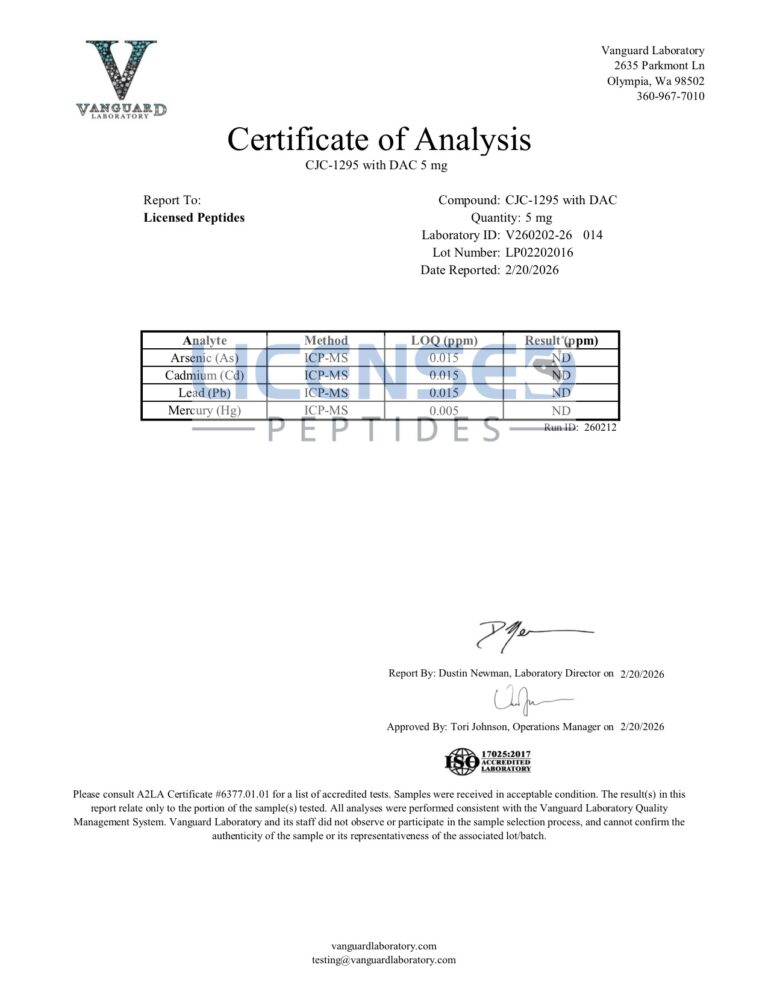
• Heavy metal screening
• Endotoxin and LPS testing
• Visual quality inspection
Endotoxin Note: We screen our CJC-1295 peptides for heavy metals, endotoxins, and lipopolysaccharides (LPS) at the compound level. Full LAL testing results are available within the product Certificate of Analysis.
HPLC separates peptide material from impurities. A reported purity of 99%+ indicates that at least 99% of the analyzed sample consists of the target peptide.
Store unopened lyophilized vials at -20°C for long-term preservation. After reconstitution, refrigerate below 4°C and avoid repeated freeze-thaw cycles.
No. We supply CJC-1295 exclusively for laboratory, analytical, and scientific research. It is not approved for human consumption, therapeutic use, veterinary applications, or diagnostic procedures.
Researchers choose Licensed Peptides because every batch of CJC with DAC includes:
• 99%+ HPLC-verified purity
• Independent third-party testing
• Mass spectrometry identity confirmation
• Heavy metal and endotoxin screening
• Batch-specific Certificates of Analysis
• GMP-certified U.S. manufacturing
• Same-day domestic shipping
• Responsive U.S.-based research support
Lyophilization removes water from the peptide under low-temperature, low-pressure conditions, producing a stable white powder.
Because moisture is removed during manufacturing, lyophilized peptides generally demonstrate greater stability during storage than peptides supplied in solution.
Product Name: CJC-1295 with DAC
Peptide Class: Growth Hormone-Releasing Hormone (GHRH) Analog
Sequence: Modified GHRH Analog with Drug Affinity Complex
Quantity: Choose from 1, 3, 5 & 10 Vial Options
Purity: 99%+ HPLC Verified
Form: Lyophilized Powder
Manufacturing: USA GMP-Certified Facility
Testing: Third-Party Verified
Documentation: Batch-Specific Certificate of Analysis Available
Storage: -20°C Long-Term
Application: Research Use Only
Background articles from the Licensed Peptides research library. All products are supplied for laboratory research use only.
Not all peptide vendors hold themselves to the same verification standards.
99.4% HPLC Verified · Endotoxin-Screened · GMP-Certified ·
Free FedEx 2-Day on $200+
You cannot copy content of this page
Third-party tested peptides, shipped cold from the U.S. in 1–2 days.
Shop all peptides