Antioxidant/Cellular Protection
Antioxidant / Cellular Protection covers the compounds used in oxidative-stress and cellular-defence research. Its anchor product is Glutathione 600mg, supplied as a lyophilised powder in a sealed vial. Studies in this area frequently run it alongside SS-31, the mitochondria-targeted peptide, and NAD+, both of which are listed under our bioregulator range and available in ten-vial kits.
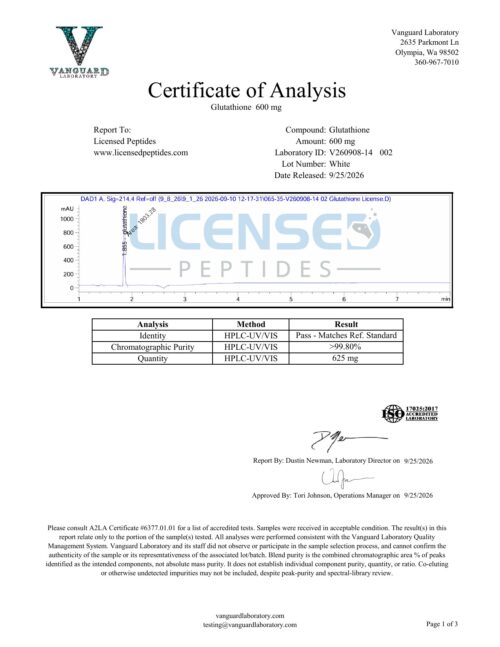
Production is GMP-certified and based in the United States, and every vial arrives as a dry lyophilised powder in cold packaging. Release testing means high-performance liquid chromatography for 99%+ purity, mass spectrometry for identity, and endotoxin and heavy-metal panels on every batch, all documented in a Certificate of Analysis you can pull up in our testing library. Material on this page is intended for laboratory research only and not for human or animal use.
-
2 for 1
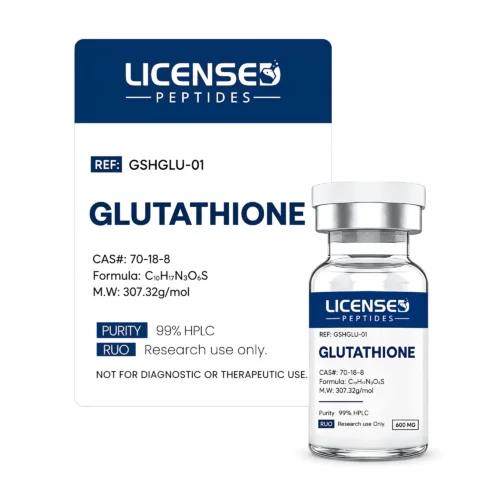 Glutathione 600mg is supplied strictly for laboratory research use only. This material is intended for analytical and controlled research applications. It is not approved or intended for human or animal use, ingestion, dosing, or therapeutic application. Glutathione is a tripeptide (glutamate–cysteine–glycine) widely used as a reference compound in redox-biology and enzymology research. Published in-vitro literature has characterised it in the following experimental contexts: Redox chemistry. The reduced (GSH) and oxidised (GSSG) forms are commonly quantified as a ratio in cell-culture models used to describe oxidative state. Interconversion between the two forms is catalysed by glutathione reductase. Conjugation chemistry. Glutathione S-transferase enzymes catalyse conjugation of glutathione to electrophilic substrates, a reaction frequently used in enzymology and metabolite-identification assays. Antioxidant cycling models. Its chemical interaction with ascorbate and tocopherol has been described in model systems. Cell-signalling literature. Intracellular glutathione concentration is reported as an experimental variable in published lymphocyte and natural-killer-cell assay models. Enzyme-inhibition literature. Interaction with tyrosinase has been described in in-vitro pigment-chemistry studies. The material is produced as a high-purity research reagent under controlled conditions, with batch-level quality control to support reproducibility across laboratory studies. This product is intended strictly for research and laboratory use only. Not for human or animal use. No statement on this page describes or implies any physiological, cosmetic, diagnostic, or therapeutic effect in humans or animals.