99%+ Purity
Guaranteed per batch

4.9 847 verified reviews




4.9 847 verified reviews
99%+ HPLC Purity —
Independently verified by accredited US laboratory
Endotoxin-Screened —
LAL tested, LPS-free, endotoxin report available
GMP-Certified Manufacturing —
USA facility, ISO 9001:2015
Lyophilized for Stability —
Shipped cold-packed, intact for reconstitution
Epithalon (also known as Epitalon) is a synthetic tetrapeptide used in laboratory research to study telomere biology, peptide signaling, and related cellular pathways in controlled experimental systems. This product is supplied strictly for research use only. It is not approved or intended for human or animal use, and any discussion of biological activity refers only to preclinical or in vitro research.
Epithalon has attracted significant interest within the fields of aging biology and molecular research due to its observed interactions with telomerase activity and telomere dynamics in controlled experimental models. Telomeres are repetitive nucleotide sequences located at the ends of chromosomes that function as protective structures, maintaining chromosomal stability during successive cellular divisions. Progressive telomere shortening has been consistently associated with cellular senescence and replicative limits in a wide range of in vitro and experimental studies.
Experimental investigations involving Epithalon have primarily focused on its molecular signaling properties, gene expression modulation, and chromosomal endpoint behavior under laboratory conditions. These findings are derived from controlled research environments and are intended solely to advance scientific understanding of cellular aging mechanisms and peptide–DNA interactions.
Epithalon supplied for research applications is typically manufactured to high purity standards and is characterized as an LPS-free peptide, endotoxin-free peptide, and research peptide endotoxin tested to ensure suitability for sensitive laboratory assays, cellular studies, and biochemical analysis. These quality attributes are critical for minimizing experimental interference and maintaining data integrity in research settings.
Importantly, Epithalon is not approved for medical, veterinary, or dietary use. All discussion surrounding this compound pertains strictly to laboratory, cellular, or experimental research settings. No claims are made regarding therapeutic outcomes, enhancement of human health, or clinical efficacy.
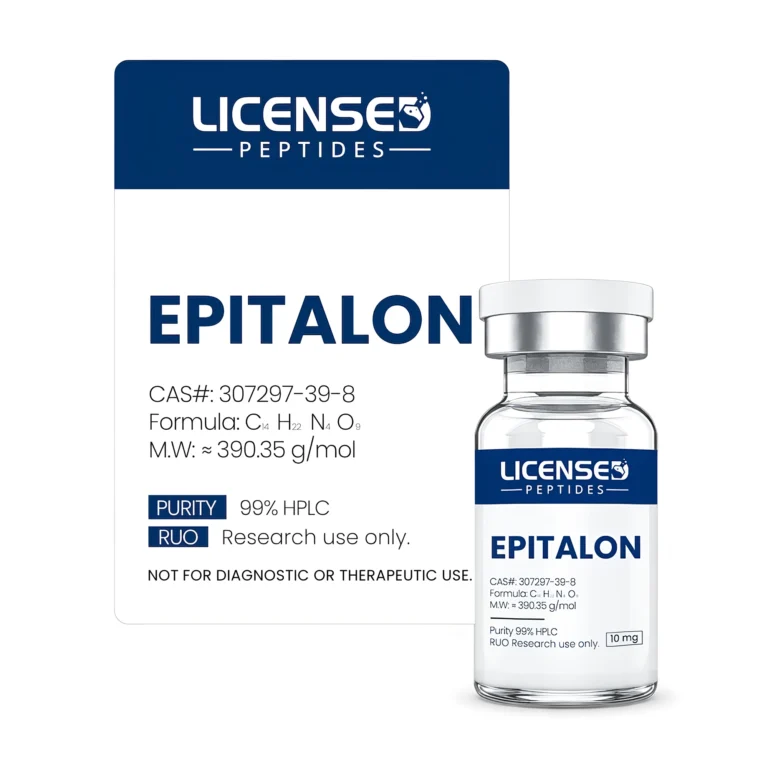
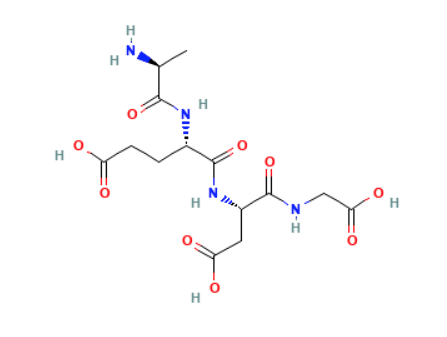
| Sequence | Ala-Glu-Asp-Gly |
|---|---|
| Molecular formula | C₁₄H₂₂N₄O₉ |
| Molecular weight | 390.349 g/mol |
| CAS number | 307297-39-8 |
| PubChem CID | 219042 |
| Form supplied | Lyophilized powder |
| Application | Research use only |
Epithalon is a laboratory research material used to examine telomere biology, cellular senescence models, and peptide-mediated signaling pathways in controlled experimental systems. References to biological effects are provided for scientific context only and must not be interpreted as claims of therapeutic, diagnostic, or clinical benefit. This product is not offered for human or veterinary use.
Epithalon is a synthetic peptide used in controlled laboratory models to study gene expression, chromosome stability, and related molecular pathways. Any discussion of pineal-gland lineage, circadian biology, or aging-associated pathways is presented solely as research context and does not imply human-use benefits.
A useful analogy often employed in educational settings compares a cell’s genome to a reference library. Telomeres act as protective bindings on each volume. With repeated copying, those bindings’ fray, risking loss of critical data. Epithalon, in this framework, is studied as a molecular signal that may influence how well those bindings are preserved during replication.
This analogy is conceptual only and is used to simplify complex genomic processes for research discussion.
The pineal gland plays a central role in circadian rhythm regulation through the secretion of melatonin. Because Epithalon is derived from peptides originally associated with pineal signaling, researchers have examined its influence on circadian-regulated gene expression and endocrine signaling patterns in experimental models.
Laboratory findings suggest that Epithalon may modulate expression patterns linked to circadian rhythm stability, particularly in aging cellular systems where rhythmic signaling tends to deteriorate. These effects are often studied through molecular markers rather than behavioral outcomes, reinforcing the strictly mechanistic nature of this research.
Another area of interest involves Epithalon’s potential relationship with oxidative stress regulation. Oxidative stress arises from an imbalance between reactive oxygen species (ROS) and cellular antioxidant defenses, contributing to DNA damage, protein misfolding, and cellular aging.
Experimental investigations have reported changes in antioxidant enzyme activity and oxidative markers following Epithalon exposure in controlled environments. Rather than directly scavenging free radicals, Epithalon appears to influence regulatory pathways responsible for maintaining intracellular redox balance.
Again, these findings are relevant solely to biochemical and molecular research and are not indicative of protective effects in living organisms.
Epithalon is commonly investigated within the following research domains:
All uses are limited to laboratory research only. This product is not intended for diagnosis, treatment, prevention, or consumption.
Epithalon is typically supplied in lyophilized (freeze-dried) form to preserve structural stability. Standard laboratory practice involves storage in cool, dry environments, often under refrigeration. Once reconstituted for experimental use, stability parameters depend on solvent choice, temperature, and duration, requiring strict adherence to research protocols.
For laboratory research use only. Products on this website are intended solely for in-vitro research. They are not medicines, have not been evaluated by the FDA, and are not intended to diagnose, treat, cure, or prevent any disease. Any administration to humans or animals is strictly prohibited.


Our peptides are produced exclusively for laboratory and scientific research purposes.
Licensed Peptides™ products are developed using industry-standard synthesis and purification protocols, making them suitable for in vitro research, analytical testing, and experimental models.
Strict process controls ensure reproducibility, allowing researchers to work with confidence across experiments.
Our peptides are commonly used in research involving:
All products are intended for research use only and are not for human or animal consumption, therapeutic use, or clinical application.
At Licensed Peptides™, quality isn’t a claim — it’s a controlled, repeatable process.
Every peptide we produce follows a strict, pharma-grade workflow designed to ensure purity, stability, and consistency from synthesis to delivery.
All peptides are synthesized in sterile, controlled environments to eliminate contamination risk and ensure batch consistency.
We use advanced High-Performance Liquid Chromatography (HPLC) to separate and verify peptide purity with precision.
Each batch undergoes heavy metal and endotoxin screening to ensure it is free from hidden contaminants.
We start with rigorously tested amino acids and reagents, ensuring integrity at the molecular level.
Freeze-dried peptides maintain long-term stability, potency, and reliability for research applications.
Every vial is protected from oxygen and moisture, preserving structural integrity during storage and transit.
From synthesis to delivery, every step is engineered to meet the expectations of professionals who require accuracy, consistency, and reliability.
For laboratory research use only. Not for human or veterinary use.
We understand that timing and product integrity are critical for research.
| Ships to | United States (including minor outlying islands) |
|---|---|
| Processing days | Monday to Friday, excluding holidays |
| Daily cut-off | Paid orders placed before 4:00 PM PST are typically shipped the same business day |
| Free shipping | FedEx 2-Day Express on orders over $200 and for VIP members |
| Standard | USPS Ground Advantage, 3–7 business days (not guaranteed) — $8.95 |
| Expedited | FedEx 2-Day $11.95 · UPS 2-Day $19.95 · FedEx Next Day $44.99 |
| Signature | Required on delivery for orders of $1,000 or more |
Products are stored in industrial-grade freezers prior to shipment to maintain stability and purity.
Each order is carefully packed to protect against temperature fluctuations, moisture exposure, and physical damage during transit.
Once your order has shipped you will receive a tracking number by email, so you can monitor delivery progress.
Orders are dispatched domestically from a U.S.-based operation, so there are no international customs steps.
Shipping times are estimates and begin after order processing. Delays may occur due to carrier issues, weather, or other unforeseen factors, and delivery dates are not guaranteed. Full terms are in our Shipping & Delivery Policy.
For laboratory research use only. Not for human or veterinary use.
| pack | 1 pack, 3 pack, 5 pack, 10 pack |
|---|
| Lyophilized, in transit | Stable for shipping for up to 3–4 months |
|---|---|
| Lyophilized, short term | Room temperature is usually adequate for several weeks; refrigeration under 4°C (39°F) is generally acceptable |
| Lyophilized, long term | Freezer at -80°C (-112°F) for several months to years |
| After reconstitution | Refrigerated; stable for up to 30 days |
| Light and moisture | Keep cold and away from light in the original sealed vial |
All of our products are manufactured using the lyophilization (freeze drying) process, which keeps them stable for shipping for up to 3–4 months.
Lyophilization is a unique dehydration process, also known as cryodesiccation, where the peptides are frozen and then subjected to low pressure. This causes the water in the peptide vial to sublimate directly from solid to gas, leaving behind a stable, crystalline white structure known as lyophilized peptide. The puffy white powder can be stored at room temperature until it is reconstituted with bacteriostatic water.
Once peptides have been received, it is imperative that they are kept cold and away from light. If the peptides will be used in the next several days, weeks or months, short-term refrigeration under 4°C (39°F) is generally acceptable. Lyophilized peptides are usually stable at room temperatures for several weeks or more, so if they will be utilized within weeks or months such storage is typically adequate.
For longer term storage (several months to years) it is more preferable to store peptides in a freezer at -80°C (-112°F). When storing peptides for months or even years, freezing is optimal in order to preserve the peptide’s stability.
Once the peptides are reconstituted with bacteriostatic water, they must be stored in the fridge to maintain stability. After reconstitution, the peptides will remain stable for up to 30 days.
For laboratory research use only. Not for human or veterinary use.
Epithalon (also known as Epitalon) is a synthetic tetrapeptide used in laboratory research to study telomere biology, peptide signaling, and related cellular pathways in controlled experimental systems. This product is supplied strictly for research use only. It is not approved or intended for human or animal use, and any discussion of biological activity refers only to preclinical or in vitro research.
Epithalon has attracted significant interest within the fields of aging biology and molecular research due to its observed interactions with telomerase activity and telomere dynamics in controlled experimental models. Telomeres are repetitive nucleotide sequences located at the ends of chromosomes that function as protective structures, maintaining chromosomal stability during successive cellular divisions. Progressive telomere shortening has been consistently associated with cellular senescence and replicative limits in a wide range of in vitro and experimental studies.
Experimental investigations involving Epithalon have primarily focused on its molecular signaling properties, gene expression modulation, and chromosomal endpoint behavior under laboratory conditions. These findings are derived from controlled research environments and are intended solely to advance scientific understanding of cellular aging mechanisms and peptide–DNA interactions.
Epithalon supplied for research applications is typically manufactured to high purity standards and is characterized as an LPS-free peptide, endotoxin-free peptide, and research peptide endotoxin tested to ensure suitability for sensitive laboratory assays, cellular studies, and biochemical analysis. These quality attributes are critical for minimizing experimental interference and maintaining data integrity in research settings.
Importantly, Epithalon is not approved for medical, veterinary, or dietary use. All discussion surrounding this compound pertains strictly to laboratory, cellular, or experimental research settings. No claims are made regarding therapeutic outcomes, enhancement of human health, or clinical efficacy.
| Sequence | Ala-Glu-Asp-Gly |
|---|---|
| Molecular formula | C₁₄H₂₂N₄O₉ |
| Molecular weight | 390.349 g/mol |
| CAS number | 307297-39-8 |
| PubChem CID | 219042 |
| Form supplied | Lyophilized powder |
| Application | Research use only |
Epithalon is a laboratory research material used to examine telomere biology, cellular senescence models, and peptide-mediated signaling pathways in controlled experimental systems. References to biological effects are provided for scientific context only and must not be interpreted as claims of therapeutic, diagnostic, or clinical benefit. This product is not offered for human or veterinary use.
Epithalon is a synthetic peptide used in controlled laboratory models to study gene expression, chromosome stability, and related molecular pathways. Any discussion of pineal-gland lineage, circadian biology, or aging-associated pathways is presented solely as research context and does not imply human-use benefits.
A useful analogy often employed in educational settings compares a cell’s genome to a reference library. Telomeres act as protective bindings on each volume. With repeated copying, those bindings’ fray, risking loss of critical data. Epithalon, in this framework, is studied as a molecular signal that may influence how well those bindings are preserved during replication.
This analogy is conceptual only and is used to simplify complex genomic processes for research discussion.
The pineal gland plays a central role in circadian rhythm regulation through the secretion of melatonin. Because Epithalon is derived from peptides originally associated with pineal signaling, researchers have examined its influence on circadian-regulated gene expression and endocrine signaling patterns in experimental models.
Laboratory findings suggest that Epithalon may modulate expression patterns linked to circadian rhythm stability, particularly in aging cellular systems where rhythmic signaling tends to deteriorate. These effects are often studied through molecular markers rather than behavioral outcomes, reinforcing the strictly mechanistic nature of this research.
Another area of interest involves Epithalon’s potential relationship with oxidative stress regulation. Oxidative stress arises from an imbalance between reactive oxygen species (ROS) and cellular antioxidant defenses, contributing to DNA damage, protein misfolding, and cellular aging.
Experimental investigations have reported changes in antioxidant enzyme activity and oxidative markers following Epithalon exposure in controlled environments. Rather than directly scavenging free radicals, Epithalon appears to influence regulatory pathways responsible for maintaining intracellular redox balance.
Again, these findings are relevant solely to biochemical and molecular research and are not indicative of protective effects in living organisms.
Epithalon is commonly investigated within the following research domains:
All uses are limited to laboratory research only. This product is not intended for diagnosis, treatment, prevention, or consumption.
Epithalon is typically supplied in lyophilized (freeze-dried) form to preserve structural stability. Standard laboratory practice involves storage in cool, dry environments, often under refrigeration. Once reconstituted for experimental use, stability parameters depend on solvent choice, temperature, and duration, requiring strict adherence to research protocols.
For laboratory research use only. Products on this website are intended solely for in-vitro research. They are not medicines, have not been evaluated by the FDA, and are not intended to diagnose, treat, cure, or prevent any disease. Any administration to humans or animals is strictly prohibited.
Our peptides are produced exclusively for laboratory and scientific research purposes.
Licensed Peptides™ products are developed using industry-standard synthesis and purification protocols, making them suitable for in vitro research, analytical testing, and experimental models.
Strict process controls ensure reproducibility, allowing researchers to work with confidence across experiments.
Our peptides are commonly used in research involving:
All products are intended for research use only and are not for human or animal consumption, therapeutic use, or clinical application.
At Licensed Peptides™, quality isn’t a claim — it’s a controlled, repeatable process.
Every peptide we produce follows a strict, pharma-grade workflow designed to ensure purity, stability, and consistency from synthesis to delivery.
All peptides are synthesized in sterile, controlled environments to eliminate contamination risk and ensure batch consistency.
We use advanced High-Performance Liquid Chromatography (HPLC) to separate and verify peptide purity with precision.
Each batch undergoes heavy metal and endotoxin screening to ensure it is free from hidden contaminants.
We start with rigorously tested amino acids and reagents, ensuring integrity at the molecular level.
Freeze-dried peptides maintain long-term stability, potency, and reliability for research applications.
Every vial is protected from oxygen and moisture, preserving structural integrity during storage and transit.
From synthesis to delivery, every step is engineered to meet the expectations of professionals who require accuracy, consistency, and reliability.
For laboratory research use only. Not for human or veterinary use.
We understand that timing and product integrity are critical for research.
| Ships to | United States (including minor outlying islands) |
|---|---|
| Processing days | Monday to Friday, excluding holidays |
| Daily cut-off | Paid orders placed before 4:00 PM PST are typically shipped the same business day |
| Free shipping | FedEx 2-Day Express on orders over $200 and for VIP members |
| Standard | USPS Ground Advantage, 3–7 business days (not guaranteed) — $8.95 |
| Expedited | FedEx 2-Day $11.95 · UPS 2-Day $19.95 · FedEx Next Day $44.99 |
| Signature | Required on delivery for orders of $1,000 or more |
Products are stored in industrial-grade freezers prior to shipment to maintain stability and purity.
Each order is carefully packed to protect against temperature fluctuations, moisture exposure, and physical damage during transit.
Once your order has shipped you will receive a tracking number by email, so you can monitor delivery progress.
Orders are dispatched domestically from a U.S.-based operation, so there are no international customs steps.
Shipping times are estimates and begin after order processing. Delays may occur due to carrier issues, weather, or other unforeseen factors, and delivery dates are not guaranteed. Full terms are in our Shipping & Delivery Policy.
For laboratory research use only. Not for human or veterinary use.
| pack | 1 pack, 3 pack, 5 pack, 10 pack |
|---|
| Lyophilized, in transit | Stable for shipping for up to 3–4 months |
|---|---|
| Lyophilized, short term | Room temperature is usually adequate for several weeks; refrigeration under 4°C (39°F) is generally acceptable |
| Lyophilized, long term | Freezer at -80°C (-112°F) for several months to years |
| After reconstitution | Refrigerated; stable for up to 30 days |
| Light and moisture | Keep cold and away from light in the original sealed vial |
All of our products are manufactured using the lyophilization (freeze drying) process, which keeps them stable for shipping for up to 3–4 months.
Lyophilization is a unique dehydration process, also known as cryodesiccation, where the peptides are frozen and then subjected to low pressure. This causes the water in the peptide vial to sublimate directly from solid to gas, leaving behind a stable, crystalline white structure known as lyophilized peptide. The puffy white powder can be stored at room temperature until it is reconstituted with bacteriostatic water.
Once peptides have been received, it is imperative that they are kept cold and away from light. If the peptides will be used in the next several days, weeks or months, short-term refrigeration under 4°C (39°F) is generally acceptable. Lyophilized peptides are usually stable at room temperatures for several weeks or more, so if they will be utilized within weeks or months such storage is typically adequate.
For longer term storage (several months to years) it is more preferable to store peptides in a freezer at -80°C (-112°F). When storing peptides for months or even years, freezing is optimal in order to preserve the peptide’s stability.
Once the peptides are reconstituted with bacteriostatic water, they must be stored in the fridge to maintain stability. After reconstitution, the peptides will remain stable for up to 30 days.
For laboratory research use only. Not for human or veterinary use.
Guaranteed per batch

Independent lab verified

Vanguard Laboratory · ISO/IEC 17025

USA-manufactured

Free FedEx on $200+

Not all peptide vendors hold themselves to the same verification standards.
| Verification Standard | Licensed Peptides | Generic Vendors |
|---|---|---|
| HPLC Purity Analysis |  99%+ Every Batch 99%+ Every Batch |
 Often Not Disclosed Often Not Disclosed |
| Mass Spectrometry Identity | Sequence Confirmed |
Rarely Available |
| Endotoxin Screening (LAL) | Every Product |
Industry Exception |
| GMP-Certified USA Manufacture | ISO 9001:2015 |
Often Overseas |
| COA Published & Downloadable | Every Lot |
Inconsistent |
| Same-Day USA Fulfillment | Before 4PM PST |
3-10 Day Lead Time |
Epithalon (also written Epitalon) is a synthetic tetrapeptide with the sequence Ala-Glu-Asp-Gly. It belongs to the group of short peptides described in the literature as bioregulators, and it is studied for its interaction with the telomerase enzyme system in cell models.
The bioregulator label comes from the research literature on short peptides that are studied for effects on gene expression and cell regulation rather than on a single receptor. Researchers use Epithalon as a reference compound in that body of work.
Published work on Epithalon centres on telomerase activity, cellular senescence and pineal-gland regulation in laboratory models. These are research contexts only and describe how the compound is studied, not an outcome for any individual.
Yes. Licensed Peptides supplies Epithalon as a lyophilized powder in a nitrogen-sealed vial. Lyophilization removes water from the finished peptide, which supports stability during storage and shipment.
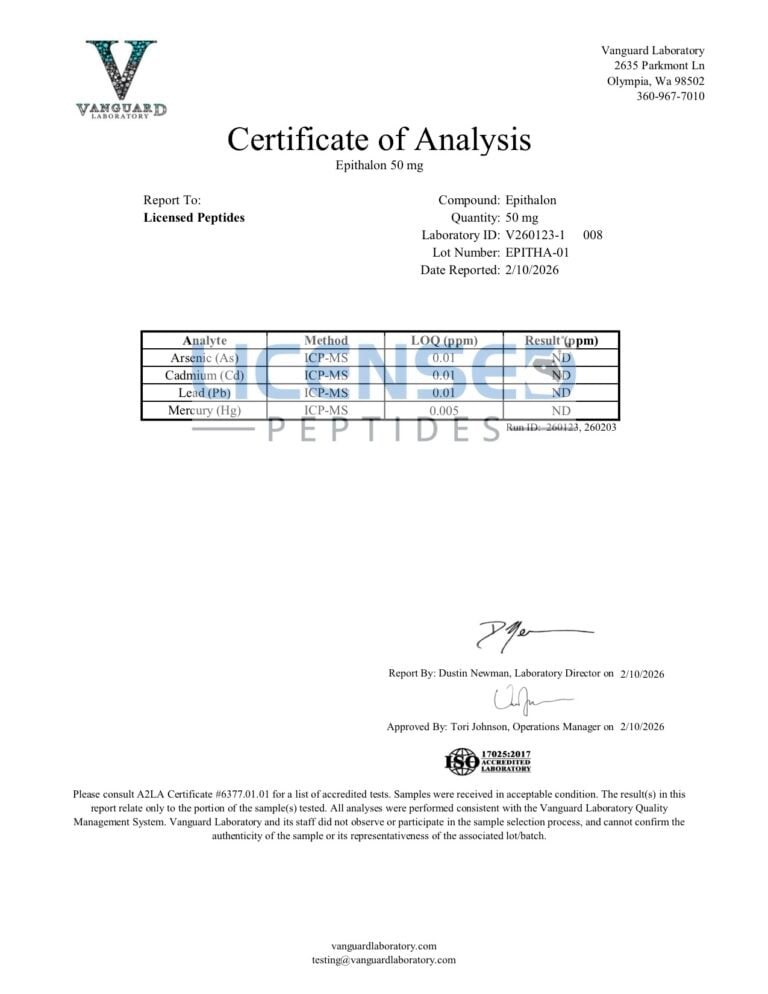
Every lot of Epithalon is tested by an independent, accredited United States laboratory. Testing covers HPLC purity at greater than 99%, mass spectrometry for identity confirmation, and LAL endotoxin screening. The Certificate of Analysis for the lot you receive is published with the product.
Endotoxin can introduce background signal into cell-based and immunological assays. Researchers working in those systems often prefer endotoxin-screened Epithalon in order to reduce unwanted experimental variability.
Identity is confirmed by mass spectrometry against the expected mass for the Ala-Glu-Asp-Gly sequence, and the result is reported on the lot’s Certificate of Analysis alongside the HPLC purity trace. Each vial carries its lot number.
High-Performance Liquid Chromatography separates the target peptide from process-related impurities. A result above 99% means that, of the material detected, more than 99% corresponds to the target peptide peak.
Epithalon is supplied in 10mg, 20mg and 50mg vials, in single vials or in multi-vial quantities. Every size ships with the same third-party Certificate of Analysis for its lot.
Lyophilized Epithalon should be kept cold and away from light in its sealed vial. Short-term storage is typically refrigerated; long-term storage is typically frozen.
Once reconstituted with bacteriostatic water, Epithalon solutions are generally kept refrigerated and used within a limited window. Stability depends on the solvent, the concentration and the handling conditions in the laboratory, so researchers document reconstitution date and storage temperature.
No. Licensed Peptides’ Epithalon for sale is exclusively for laboratory, research and in vitro use. It is not a drug, is not intended for human or veterinary use, and is not for diagnostic or therapeutic purposes.
An Epithalon peptide buy starts with documented quality: US manufacture, third-party lot testing, a published Certificate of Analysis, nitrogen-sealed lyophilized vials and same-day shipping on orders placed before 4PM PST.
Not all peptide vendors hold themselves to the same verification standards.
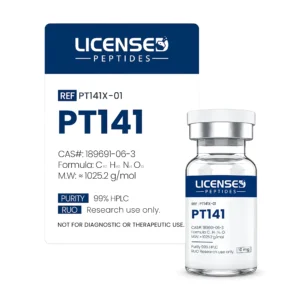
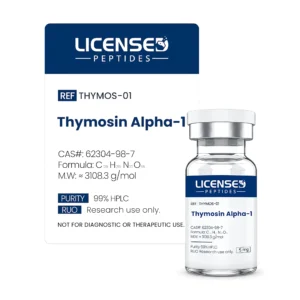
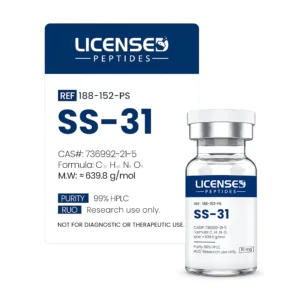
99.4% HPLC Verified · Endotoxin-Screened · GMP-Certified ·
Free FedEx 2-Day on $200+
You cannot copy content of this page
Third-party tested peptides, shipped cold from the U.S. in 1–2 days.
Shop all peptides