
99%+ Purity
Guaranteed per batch

4.9 847 verified reviews





4.9 847 verified reviews
99%+ HPLC Purity —
Independently verified by accredited US laboratory
Endotoxin-Screened —
LAL tested, LPS-free, endotoxin report available
GMP-Certified Manufacturing —
USA facility, ISO 9001:2015
Lyophilized for Stability —
Shipped cold-packed, intact for reconstitution
Get high-quality, high purity GHK-Cu peptides for research involving copper binding, cell signaling, fibroblast activity, and extracellular-matrix processes. Our lyophilized GHK-Cu comes in both 50 mg and 100 mg strengths to suit a wide range of studies.
Disclaimer: Licensed Peptides supplies GHK-Cu for laboratory research, analytical testing, and controlled scientific applications. It isn’t intended for human or animal consumption, administration, therapeutic use, clinical use, veterinary use, diagnosis, treatment, cure, or prevention of any disease or medical condition.
GHK-Cu is a peptide-metal complex that contains three amino acids that are linked together:
• Glycine
• Histidine
• Lysine
The tripeptide glycyl-L-histidyl-L-lysine forms bonds (or chelates) with a copper ion to create the complex GHK-Cu. The nitrogen and oxygen atoms that are found within the GHK molecule grip the copper ion tightly.
When it coordinates with copper, we can call GHK-Cu a metallopeptide, which means it’s a molecule that’s bound with metal ions. Researchers are interested in whether copper coordination influences the peptide’s molecular structure, biochemical interactions, and behavior in controlled laboratory studies.¹˒²
GHK-Cu is studied in laboratory research involving the following areas:
• How GHK-Cu binds copper and carries it to cells and tissue
• How the peptide and copper form a stable complex
• How GHK-Cu interacts with fibroblasts (they help produce structural materials around cells)
• Its relationship with the extracellular matrix, the support network surrounding cells
• How it may influence signals that are involved in cell growth
• Its interaction with cells that line blood vessels
• Its role in laboratory models of new blood vessel formation
• How it may affect which genes are switched on or off
• Its involvement in maintaining cells
• How cells respond to oxidative stress
Researchers who are interested in comparing single-peptide and blended research materials may also like to review our Klow Peptide blend. This blend contains GHK-Cu alongside BPC-157, KPV, and TB-500 peptides.
Source: PubChem CID 139035031
Sequence: Gly-His-Lys, copper(II) complex
Length: 3 amino acids
Molecular Formula: C14H21CuN6O4- (Cu complex); C14H24N6O4 (free GHK)
Mass: 400.09 Da (Cu complex, monoisotopic); 340.19 Da (free GHK)
GHK was identified in human plasma in 1973 and its plasma concentration is reported to decline with age, which is why it appears so often in the ageing literature. Its defining property is a very high affinity for copper(II); the peptide is almost always studied as the copper complex rather than as the free tripeptide, and the two have different PubChem records and different molecular formulas.
Research on GHK-Cu centres on three areas: copper delivery to cells and the redox chemistry that follows; broad modulation of gene expression, with published microarray work reporting changes across large numbers of transcripts; and effects on collagen, glycosaminoglycan and metalloproteinase balance in dermal fibroblast models. Antioxidant and anti-inflammatory endpoints are also examined.
GHK-Cu may be used in laboratory studies involving:
All uses are limited to research settings only. This product is not intended for human or animal use.
Published literature describes GHK-Cu in cell-culture, rodent and human dermatological research settings. Those observations are summarised here as research context only and are not claims of safety, effectiveness or suitability for human or veterinary use.
Research Focus: Cellular Pathway Research
Title: GHK Peptide as a Natural Modulator of Multiple Cellular Pathways in Skin Regeneration (BioMed Research International, 2015)
Authors: Loren Pickart, Anna Margolina
Research Focus: Oxidative Stress and Ageing Research
Title: The Human Tripeptide GHK-Cu in Prevention of Oxidative Stress and Degenerative Conditions of Aging (Oxidative Medicine and Cellular Longevity, 2012)
Authors: Loren Pickart, Jessica M. Vasquez-Soltero, Anna Margolina


Storing lyophilized GHK-Cu properly will help preserve the stability of the peptide during laboratory inventory and experimental planning.
Here are our recommended requirements for storing unopened GHK-Cu:
• Keep peptides at -20°C for long-term storage
• Protect GHK-Cu from direct light
• Protect GHK-Cu from moisture
• Keep the molecule in its original sealed vial
Avoid unnecessary temperature cycling (repeated changes from warmer to cooler temperatures)

Scientists are interested in studying the GHK-Cu peptide because of its structure; it’s made up of a short peptide sequence (tripeptide) with a coordinated copper ion. This specific structure lets researchers examine peptide signaling (biological messages) and peptide–metal interactions (how a metal atom alters the peptide’s shape and stability) within a single experimental framework, rather than through separate testing.
Scientists are interested in the following areas of study:
• Copper-binding chemistry
• Peptide-metal complex formation
• Fibroblast assays
• Extracellular-matrix biology
• Growth-factor signaling
• Endothelial-cell pathways
• Angiogenesis-related experimental models
• Gene-expression datasets
• Cellular maintenance pathways
• Oxidative-stress response mechanisms
Copper Coordination and Biochemical Interactions
Laboratory studies have examined how GHK binds to copper and what that final molecule looks like. Scientific researchers are also interested in investigating how this compound interacts with other substances.¹˒²
Binding GHK to copper may affect:
• The shape of the molecule
• How it attaches to other molecules
• How its electrical charge is distributed
• How stable it remains during experiments
• How the molecule interacts with other compounds
These properties can change depending on a range of various factors, including acidity, concentration, the liquid used in the experiment, as well as other laboratory conditions.
Fibroblasts are cells that help make and organize the supportive material and structural proteins surrounding cells and tissues, such as collagen and elastin. This support network is called the extracellular matrix (ECM), and it refers to the framework where cells sit. Laboratory studies and in-vitro experiments have used cells outside the body to examine how fibroblasts grow and produce signaling proteins after they’ve been exposed to copper tripeptide.³
Within these experiments, researchers are interested in studying:
• Fibroblast growth and proliferation
• Cell-to-cell signaling
• Production of growth-related signaling proteins
• Extracellular-matrix organization
• Matrix breakdown and remodeling
• The effect of copper binding on experimental outcomes
Endothelial-Cell and Angiogenesis-Related Models
Endothelial cells create a lining inside blood vessels (endothelium). Angiogenesis is the process of forming new blood vessels from existing ones when tissue is damaged or growing and in need of oxygen and nutrients.
A 2017 study examined a liposomal form of GHK-Cu in cultured human endothelial cells and a mouse scald model. The liposomal formulation increased endothelial-cell proliferation by 33.1% and increased the expression of VEGF and FGF-2, two proteins involved in blood-vessel formation. In the mouse model, researchers also recorded stronger CD31 and Ki67 signals and greater angiogenesis than with free GHK-Cu.
These results apply specifically to the liposomal formulation and experimental models used in the study. Researchers should not assume that other forms of GHK-Cu will produce the same findings.
Scientific reviews have explored possible links between GHK or GHK-Cu and gene activity, including:
• Extracellular-matrix breakdown and remodeling
• Maintenance of normal cellular function
• Cellular responses to oxidative stress
• Protein degradation pathways
• Regulation of intracellular signaling
Most of this evidence comes from laboratory studies, including in-vitro studies and animal research, or scientific reviews.
1. Bossak-Ahmad K, Winiewska MD, Bal W, Drew SC, Frczyk T. Ternary Cu(II) complex with GHK peptide and cis-urocanic acid as a potential physiologically functional copper chelate. International Journal of Molecular Sciences. 2020;21(17):6190.
2. Conato C, et al. Copper complexes of glycyl-histidyl-lysine and two of its synthetic analogues: chemical behaviour and biological activity. 2001.
3. Pollard JD, Quan S, Kang T, Koch RJ. Effects of copper tripeptide on the growth and expression of growth factors by normal and irradiated fibroblasts. Archives of Facial Plastic Surgery. 2005;7(1):27–31.
Wang X, et al. GHK-Cu-liposomes accelerate scald wound healing in mice by promoting cell proliferation and angiogenesis. Wound Repair and Regeneration. 2017;25(2):270–278.
4. Pickart L, Margolina A. Regenerative and protective actions of the GHK-Cu peptide in the light of the new gene data. International Journal of Molecular Sciences. 2018;19(7):1987.
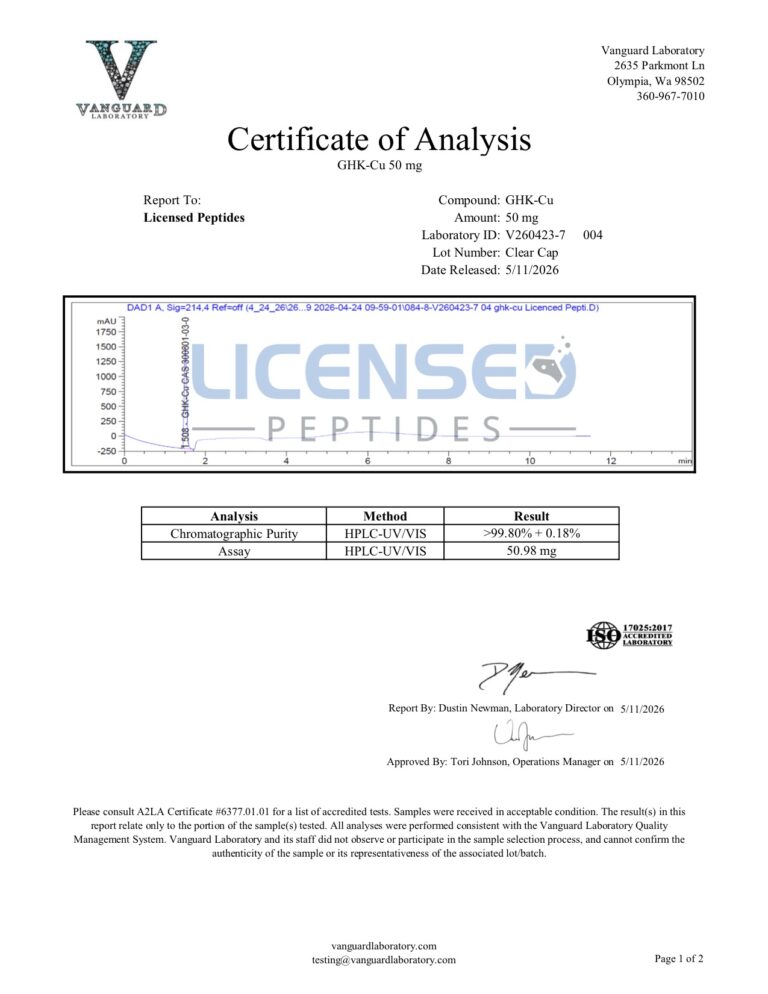
We test every batch of GHK-Cu peptide before releasing it for research to ensure its quality and stability remain intact.
Independent laboratories use HPLC analysis to measure the proportion of GHK-Cu within each tested sample. This ensures high-purity with every peptide.
HPLC measures chromatographic purity, and ICP-MS evaluates trace metals for each batch, so researchers can trust in the quality and purity of their peptide batch.
Our peptides come with a report that identifies important information like the product, strength, laboratory ID, testing method, report date, and recorded results. This means that for every sample, researchers get clear, traceable data.
At Licensed Peptides, we freeze-dry GHK-Cu and seal each vial under nitrogen. This limits how much the vials are exposed to moisture and oxygen while they’re being stored and in transit.
We offer reliable domestic shipping fulfillment:
Same-Day U.S. Shipping
Orders placed before the daily cutoff are eligible to be dispatched the same business day. Orders must be in stock and will be dispatched from within the United States.
Controlled Storage Before Dispatch
We store our products in temperature-controlled conditions before shipping. This protects the material in its lyophilized form.
Secure and Protective Packaging
We package each GHK-Cu batch in safe and secure packaging to reduce its exposure to factors that may begin the process of degradation. This includes:
• Moisture
• Direct light
• Temperature fluctuations
• Physical damage during transit
• Real-Time Tracking
Once we’ve processed your order, our tracking information makes it easy to monitor the shipment – from dispatch through to delivery.
Get high-quality, high purity GHK-Cu peptides for research involving copper binding, cell signaling, fibroblast activity, and extracellular-matrix processes. Our lyophilized GHK-Cu comes in both 50 mg and 100 mg strengths to suit a wide range of studies.
Disclaimer: Licensed Peptides supplies GHK-Cu for laboratory research, analytical testing, and controlled scientific applications. It isn’t intended for human or animal consumption, administration, therapeutic use, clinical use, veterinary use, diagnosis, treatment, cure, or prevention of any disease or medical condition.
Storing lyophilized GHK-Cu properly will help preserve the stability of the peptide during laboratory inventory and experimental planning.
Here are our recommended requirements for storing unopened GHK-Cu:
• Keep peptides at -20°C for long-term storage
• Protect GHK-Cu from direct light
• Protect GHK-Cu from moisture
• Keep the molecule in its original sealed vial
Avoid unnecessary temperature cycling (repeated changes from warmer to cooler temperatures)
Scientists are interested in studying the GHK-Cu peptide because of its structure; it’s made up of a short peptide sequence (tripeptide) with a coordinated copper ion. This specific structure lets researchers examine peptide signaling (biological messages) and peptide–metal interactions (how a metal atom alters the peptide’s shape and stability) within a single experimental framework, rather than through separate testing.
Scientists are interested in the following areas of study:
• Copper-binding chemistry
• Peptide-metal complex formation
• Fibroblast assays
• Extracellular-matrix biology
• Growth-factor signaling
• Endothelial-cell pathways
• Angiogenesis-related experimental models
• Gene-expression datasets
• Cellular maintenance pathways
• Oxidative-stress response mechanisms
Copper Coordination and Biochemical Interactions
Laboratory studies have examined how GHK binds to copper and what that final molecule looks like. Scientific researchers are also interested in investigating how this compound interacts with other substances.¹˒²
Binding GHK to copper may affect:
• The shape of the molecule
• How it attaches to other molecules
• How its electrical charge is distributed
• How stable it remains during experiments
• How the molecule interacts with other compounds
These properties can change depending on a range of various factors, including acidity, concentration, the liquid used in the experiment, as well as other laboratory conditions.
Fibroblasts are cells that help make and organize the supportive material and structural proteins surrounding cells and tissues, such as collagen and elastin. This support network is called the extracellular matrix (ECM), and it refers to the framework where cells sit. Laboratory studies and in-vitro experiments have used cells outside the body to examine how fibroblasts grow and produce signaling proteins after they’ve been exposed to copper tripeptide.³
Within these experiments, researchers are interested in studying:
• Fibroblast growth and proliferation
• Cell-to-cell signaling
• Production of growth-related signaling proteins
• Extracellular-matrix organization
• Matrix breakdown and remodeling
• The effect of copper binding on experimental outcomes
Endothelial-Cell and Angiogenesis-Related Models
Endothelial cells create a lining inside blood vessels (endothelium). Angiogenesis is the process of forming new blood vessels from existing ones when tissue is damaged or growing and in need of oxygen and nutrients.
A 2017 study examined a liposomal form of GHK-Cu in cultured human endothelial cells and a mouse scald model. The liposomal formulation increased endothelial-cell proliferation by 33.1% and increased the expression of VEGF and FGF-2, two proteins involved in blood-vessel formation. In the mouse model, researchers also recorded stronger CD31 and Ki67 signals and greater angiogenesis than with free GHK-Cu.
These results apply specifically to the liposomal formulation and experimental models used in the study. Researchers should not assume that other forms of GHK-Cu will produce the same findings.
Scientific reviews have explored possible links between GHK or GHK-Cu and gene activity, including:
• Extracellular-matrix breakdown and remodeling
• Maintenance of normal cellular function
• Cellular responses to oxidative stress
• Protein degradation pathways
• Regulation of intracellular signaling
Most of this evidence comes from laboratory studies, including in-vitro studies and animal research, or scientific reviews.
1. Bossak-Ahmad K, Winiewska MD, Bal W, Drew SC, Frczyk T. Ternary Cu(II) complex with GHK peptide and cis-urocanic acid as a potential physiologically functional copper chelate. International Journal of Molecular Sciences. 2020;21(17):6190.
2. Conato C, et al. Copper complexes of glycyl-histidyl-lysine and two of its synthetic analogues: chemical behaviour and biological activity. 2001.
3. Pollard JD, Quan S, Kang T, Koch RJ. Effects of copper tripeptide on the growth and expression of growth factors by normal and irradiated fibroblasts. Archives of Facial Plastic Surgery. 2005;7(1):27–31.
Wang X, et al. GHK-Cu-liposomes accelerate scald wound healing in mice by promoting cell proliferation and angiogenesis. Wound Repair and Regeneration. 2017;25(2):270–278.
4. Pickart L, Margolina A. Regenerative and protective actions of the GHK-Cu peptide in the light of the new gene data. International Journal of Molecular Sciences. 2018;19(7):1987.
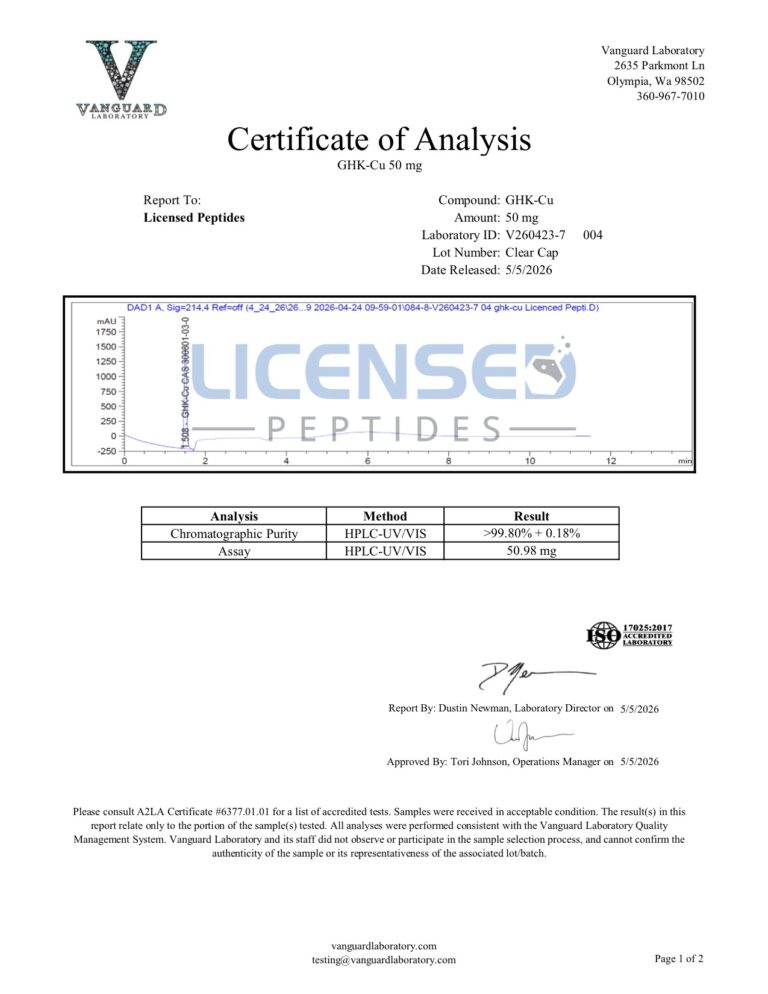
We test every batch of GHK-Cu peptide before releasing it for research to ensure its quality and stability remain intact.
Independent laboratories use HPLC analysis to measure the proportion of GHK-Cu within each tested sample. This ensures high-purity with every peptide.
HPLC measures chromatographic purity, and ICP-MS evaluates trace metals for each batch, so researchers can trust in the quality and purity of their peptide batch.
Our peptides come with a report that identifies important information like the product, strength, laboratory ID, testing method, report date, and recorded results. This means that for every sample, researchers get clear, traceable data.
At Licensed Peptides, we freeze-dry GHK-Cu and seal each vial under nitrogen. This limits how much the vials are exposed to moisture and oxygen while they’re being stored and in transit.
We offer reliable domestic shipping fulfillment:
Same-Day U.S. Shipping
Orders placed before the daily cutoff are eligible to be dispatched the same business day. Orders must be in stock and will be dispatched from within the United States.
Controlled Storage Before Dispatch
We store our products in temperature-controlled conditions before shipping. This protects the material in its lyophilized form.
Secure and Protective Packaging
We package each GHK-Cu batch in safe and secure packaging to reduce its exposure to factors that may begin the process of degradation. This includes:
• Moisture
• Direct light
• Temperature fluctuations
• Physical damage during transit
• Real-Time Tracking
Once we’ve processed your order, our tracking information makes it easy to monitor the shipment – from dispatch through to delivery.
Guaranteed per batch

Independent lab verified

ISO/IEC 17025:2017

USA-manufactured

Free FedEx on $200+
Every batch is independently tested before it ships. Full documentation available for every product.
 99%+ — Passes ≥99%
Confirmed — 1419.6 m/z
<1.0 EU/mg — LPS-Free
No growth detected
Blue lyophilized powder
All 15 residues confirmed
±0.2% — Within spec
ISO/IEC 17025:2017
GMP / ISO 9001:2015
2026
Verified
99%+ — Passes ≥99%
Confirmed — 1419.6 m/z
<1.0 EU/mg — LPS-Free
No growth detected
Blue lyophilized powder
All 15 residues confirmed
±0.2% — Within spec
ISO/IEC 17025:2017
GMP / ISO 9001:2015
2026
Verified
 Download Full COA / HPLC Report (PDF)

Not all peptide vendors hold themselves to the same verification standards.
| Verification Standard | Licensed Peptides | Generic Vendors |
|---|---|---|
| HPLC Purity Analysis |  99%+ Every Batch 99%+ Every Batch |
 Often Not Disclosed Often Not Disclosed |
| Mass Spectrometry Identity | Sequence Confirmed |
Rarely Available |
| Endotoxin Screening (LAL) | Every Product |
Industry Exception |
| GMP-Certified USA Manufacture | ISO 9001:2015 |
Often Overseas |
| COA Published & Downloadable | Every Lot |
Inconsistent |
| Same-Day USA Fulfillment | Before 4PM PST |
3-10 Day Lead Time |
GHK-Cu is a copper-binding tripeptide made from glycine, histidine, and lysine. This particular peptide binds with a copper ion, which creates a peptide-metal complex that researchers can examine in biochemical and cell-based studies.
Researchers study GHK-Cu in laboratory models for a number of reasons:
• Copper coordination (how the GHK peptide binds and transports copper ions)
• Cell signaling (how it delivers messages to direct cellular action, such as repairing damaged structures)
• Fibroblast activity (how GHK-Cu affects the primary builder cells in connective tissue and skin)
• Extracellular-matrix processes (how GHK-Cu helps manage and rebuild the structure that surrounds cells)
• Gene expression (the ability for GHK-Cu to turn specific genes “on” and “off”)
Yes, GHK-Cu occurs naturally. It was first isolated in 1973 from human blood plasma by biochemist Dr. Loren Pickart. As well as blood plasma, researchers have identified GHK and its copper-bound complex in biological systems. Naturally occurring levels vary according to the biological material being measured, in addition to the analytical method.
The difference between GHK and GHK-Cu is simple. GHK refers to the three-amino-acid peptide that exists without bound copper (the “Cu”). GHK-Cu refers to the complex that’s formed when GHK coordinates with a copper ion. This distinction is important, as it can affect the compound’s chemical behavior in laboratory studies.
Copper is important in GHK-Cu research because it’s the central metal component of the GHK-Cu complex. Researchers are interested in examining how GHK binds and transports copper and how this interaction affects biochemical signaling under controlled experimental conditions.
Some cell-culture studies have examined GHK-Cu in relation to fibroblast activity, collagen production, and extracellular-matrix signaling, all of which link to collagen-related pathways.
LPS stands for “lipopolysaccharide”, a component of certain bacterial cell walls. LPS is an endotoxin; even tiny trace amounts can bring unwanted variables into sensitive laboratory assays, which causes skewed experiments and ruined data. Because of this, laboratories use endotoxin testing to assess the presence of LPS. At Licensed Peptides, we ensure all GHK-Cu undergo endotoxin screening to ensure the peptide’s purity and quality.
Each report identifies:
• Product name
• Product strength
• Laboratory ID
• Lot or sample identifier
• Report date
• Testing laboratory
• Analytical method
• Chromatographic purity
• Measured quantity
• Applicable heavy-metal results
Here at Licensed Peptides, we supply GHK-Cu as a lyophilized research material. When preparing for laboratory research, ensure you select solvents, buffers, and working concentrations according to:
• The selected experimental model
• Validated laboratory procedures
• The analytical method you require
• The intended assay conditions
• The accompanying product documentation
If you would like more general laboratory information, you can refer to our Peptide Solubility Guide.
Not all peptide vendors hold themselves to the same verification standards.

99.4% HPLC Verified · Endotoxin-Screened · GMP-Certified ·
Free FedEx 2-Day on $200+
You cannot copy content of this page
Third-party tested peptides, shipped cold from the U.S. in 1–2 days.
Shop all peptides