
99%+ Purity
Guaranteed per batch

4.9 847 verified reviews

4.9 847 verified reviews
99%+ HPLC Purity —
Independently verified by accredited US laboratory
Endotoxin-Screened —
LAL tested, LPS-free, endotoxin report available
GMP-Certified Manufacturing —
USA facility, ISO 9001:2015
Lyophilized for Stability —
Shipped cold-packed, intact for reconstitution
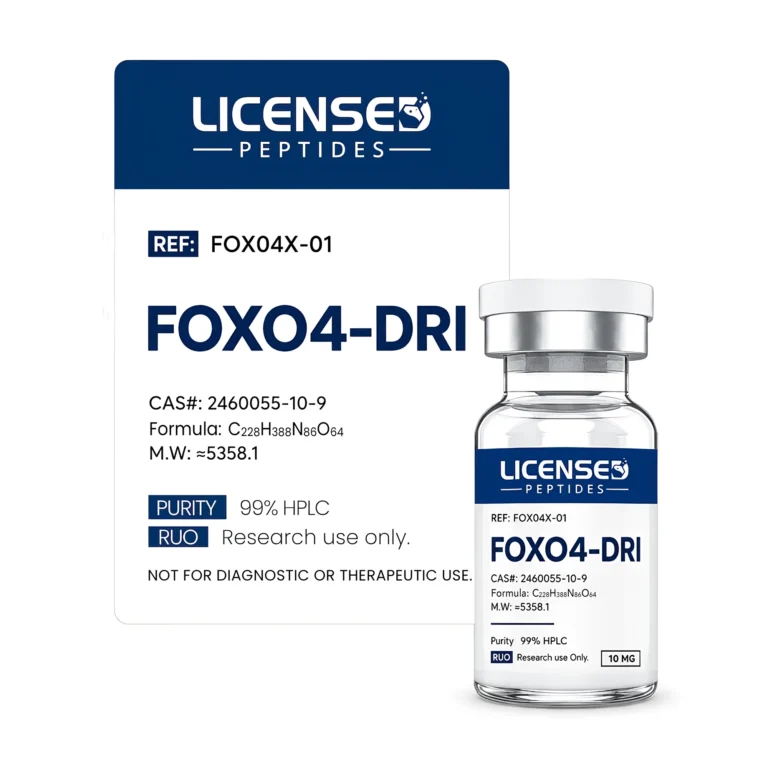
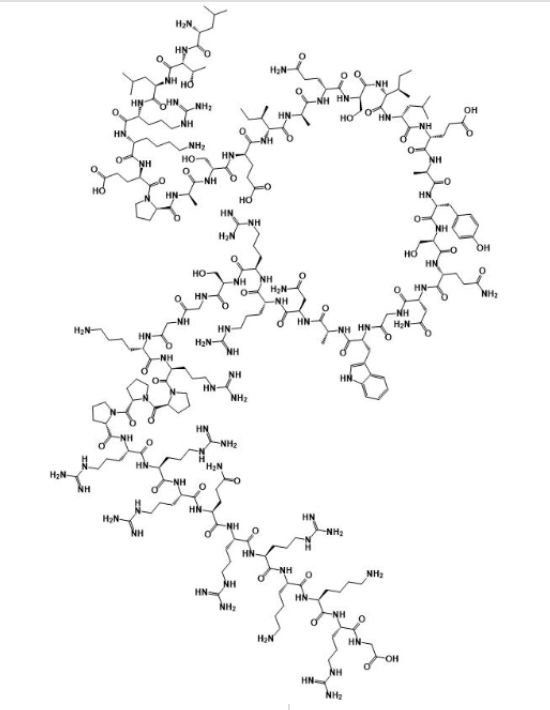
FOXO4-DRI (FOXO4-D-Retro-Inverso) is a synthetic senolytic research peptide designed to interfere with the interaction between the transcription factor FOXO4 and the tumor-suppressor protein p53. This interaction is associated with the survival of senescent cells. By disrupting the FOXO4–p53 interaction, FOXO4-DRI has been investigated for its ability to promote apoptosis, or programmed cell death, in selected senescent-cell models.
| Molecular formula | C228H388N86O64 |
|---|---|
| Molecular weight | 5,358.06 g/mol |
| CAS number | 2460055-10-9 |
| Application | Research use only |
FOXO4-DRI is a synthetic D-retro-inverso (DRI) peptide developed as a research tool for investigating the molecular mechanisms underlying cellular senescence. The peptide is derived from a region of the FOXO4 forkhead domain and was designed to interfere with the interaction between FOXO4 and the tumor-suppressor protein p53, a protein-protein interaction that has been implicated in the survival of senescent cells.
In preclinical research, FOXO4-DRI has been studied for its potential senolytic activity, referring to the selective targeting and removal of certain senescent cells. Experimental studies suggest that FOXO4-DRI competes with endogenous FOXO4 for binding to p53. This disruption can promote the redistribution of activated p53 away from the nucleus and contribute to the activation of apoptosis-related pathways in susceptible senescent cells.
Research involving cultured human cells has reported that FOXO4-DRI can reduce the viability of selected senescent cell populations while showing comparatively less effect on non-senescent cells under certain experimental conditions. Studies have investigated its activity in several cellular models, including fibroblasts and chondrocytes, providing researchers with a tool for examining the relationship between cellular senescence, p53 signaling, and programmed cell death.
The peptide was designed as a chemical probe of the FOXO4–p53 interaction, which had been identified as a node in senescent cells; a proteolysis-resistant competitor was needed to test whether disrupting that interaction would change the fate of those cells.2
Reported laboratory work used senescent cell cultures with viability and apoptosis readouts, immunoprecipitation to confirm disruption of the FOXO4–p53 complex, and mouse models of chemotoxicity and ageing.2
This is the foundational study associated with FOXO4-DRI. The researchers investigated the FOXO4–p53 interaction and developed an all-D-amino-acid peptide designed to disrupt this interaction. In cellular and mouse models, FOXO4-DRI was investigated for its ability to induce apoptosis in senescent cells and improve selected measures of tissue homeostasis.
This study provides additional structural insight into the FOXO4–p53 interaction, which is directly relevant to understanding the molecular basis of FOXO4-DRI activity. It focuses on the structural flexibility and interaction between FOXO proteins and the p53 transactivation domain.
Baar and colleagues reported that a FOXO4-based retro-inverso peptide caused targeted apoptosis of senescent cells in culture and altered tissue readouts in mouse models of chemotoxicity and ageing.2
Supplied as a lyophilised powder. Store as stated in the specification box above, protected from light and moisture, and keep the vial sealed until use.
For laboratory research use only. Products on this website are intended solely for in-vitro research. They are not medicines, have not been evaluated by the FDA, and are not intended to diagnose, treat, cure, or prevent any disease. Any administration to humans or animals is strictly prohibited.

Our peptides are produced exclusively for laboratory and scientific research purposes.
Licensed Peptides™ products are developed using industry-standard synthesis and purification protocols, making them suitable for in vitro research, analytical testing, and experimental models.
Strict process controls ensure reproducibility, allowing researchers to work with confidence across experiments.
Our peptides are commonly used in research involving:
All products are intended for research use only and are not for human or animal consumption, therapeutic use, or clinical application.
At Licensed Peptides™, quality isn’t a claim — it’s a controlled, repeatable process.
Every peptide we produce follows a strict, pharma-grade workflow designed to ensure purity, stability, and consistency from synthesis to delivery.
All peptides are synthesized in sterile, controlled environments to eliminate contamination risk and ensure batch consistency.
We use advanced High-Performance Liquid Chromatography (HPLC) to separate and verify peptide purity with precision.
Each batch undergoes heavy metal and endotoxin screening to ensure it is free from hidden contaminants.
We start with rigorously tested amino acids and reagents, ensuring integrity at the molecular level.
Freeze-dried peptides maintain long-term stability, potency, and reliability for research applications.
Every vial is protected from oxygen and moisture, preserving structural integrity during storage and transit.
From synthesis to delivery, every step is engineered to meet the expectations of professionals who require accuracy, consistency, and reliability.
For laboratory research use only. Not for human or veterinary use.
We understand that timing and product integrity are critical for research.
| Ships to | United States (including minor outlying islands) |
|---|---|
| Processing days | Monday to Friday, excluding holidays |
| Daily cut-off | Paid orders placed before 4:00 PM PST are typically shipped the same business day |
| Free shipping | FedEx 2-Day Express on orders over $200 and for VIP members |
| Standard | USPS Ground Advantage, 3–7 business days (not guaranteed) — $8.95 |
| Expedited | FedEx 2-Day $11.95 · UPS 2-Day $19.95 · FedEx Next Day $44.99 |
| Signature | Required on delivery for orders of $1,000 or more |
Products are stored in industrial-grade freezers prior to shipment to maintain stability and purity.
Each order is carefully packed to protect against temperature fluctuations, moisture exposure, and physical damage during transit.
Once your order has shipped you will receive a tracking number by email, so you can monitor delivery progress.
Orders are dispatched domestically from a U.S.-based operation, so there are no international customs steps.
Shipping times are estimates and begin after order processing. Delays may occur due to carrier issues, weather, or other unforeseen factors, and delivery dates are not guaranteed. Full terms are in our Shipping & Delivery Policy.
For laboratory research use only. Not for human or veterinary use.
| Lyophilized, in transit | Stable for shipping for up to 3–4 months |
|---|---|
| Lyophilized, short term | Room temperature is usually adequate for several weeks; refrigeration under 4°C (39°F) is generally acceptable |
| Lyophilized, long term | Freezer at -80°C (-112°F) for several months to years |
| After reconstitution | Refrigerated; stable for up to 30 days |
| Light and moisture | Keep cold and away from light in the original sealed vial |
All of our products are manufactured using the lyophilization (freeze drying) process, which keeps them stable for shipping for up to 3–4 months.
Lyophilization is a unique dehydration process, also known as cryodesiccation, where the peptides are frozen and then subjected to low pressure. This causes the water in the peptide vial to sublimate directly from solid to gas, leaving behind a stable, crystalline white structure known as lyophilized peptide. The puffy white powder can be stored at room temperature until it is reconstituted with bacteriostatic water.
Once peptides have been received, it is imperative that they are kept cold and away from light. If the peptides will be used in the next several days, weeks or months, short-term refrigeration under 4°C (39°F) is generally acceptable. Lyophilized peptides are usually stable at room temperatures for several weeks or more, so if they will be utilized within weeks or months such storage is typically adequate.
For longer term storage (several months to years) it is more preferable to store peptides in a freezer at -80°C (-112°F). When storing peptides for months or even years, freezing is optimal in order to preserve the peptide’s stability.
Once the peptides are reconstituted with bacteriostatic water, they must be stored in the fridge to maintain stability. After reconstitution, the peptides will remain stable for up to 30 days.
For laboratory research use only. Not for human or veterinary use.
FOXO4-DRI (FOXO4-D-Retro-Inverso) is a synthetic senolytic research peptide designed to interfere with the interaction between the transcription factor FOXO4 and the tumor-suppressor protein p53. This interaction is associated with the survival of senescent cells. By disrupting the FOXO4–p53 interaction, FOXO4-DRI has been investigated for its ability to promote apoptosis, or programmed cell death, in selected senescent-cell models.
| Molecular formula | C228H388N86O64 |
|---|---|
| Molecular weight | 5,358.06 g/mol |
| CAS number | 2460055-10-9 |
| Application | Research use only |
FOXO4-DRI is a synthetic D-retro-inverso (DRI) peptide developed as a research tool for investigating the molecular mechanisms underlying cellular senescence. The peptide is derived from a region of the FOXO4 forkhead domain and was designed to interfere with the interaction between FOXO4 and the tumor-suppressor protein p53, a protein-protein interaction that has been implicated in the survival of senescent cells.
In preclinical research, FOXO4-DRI has been studied for its potential senolytic activity, referring to the selective targeting and removal of certain senescent cells. Experimental studies suggest that FOXO4-DRI competes with endogenous FOXO4 for binding to p53. This disruption can promote the redistribution of activated p53 away from the nucleus and contribute to the activation of apoptosis-related pathways in susceptible senescent cells.
Research involving cultured human cells has reported that FOXO4-DRI can reduce the viability of selected senescent cell populations while showing comparatively less effect on non-senescent cells under certain experimental conditions. Studies have investigated its activity in several cellular models, including fibroblasts and chondrocytes, providing researchers with a tool for examining the relationship between cellular senescence, p53 signaling, and programmed cell death.
The peptide was designed as a chemical probe of the FOXO4–p53 interaction, which had been identified as a node in senescent cells; a proteolysis-resistant competitor was needed to test whether disrupting that interaction would change the fate of those cells.2
Reported laboratory work used senescent cell cultures with viability and apoptosis readouts, immunoprecipitation to confirm disruption of the FOXO4–p53 complex, and mouse models of chemotoxicity and ageing.2
This is the foundational study associated with FOXO4-DRI. The researchers investigated the FOXO4–p53 interaction and developed an all-D-amino-acid peptide designed to disrupt this interaction. In cellular and mouse models, FOXO4-DRI was investigated for its ability to induce apoptosis in senescent cells and improve selected measures of tissue homeostasis.
This study provides additional structural insight into the FOXO4–p53 interaction, which is directly relevant to understanding the molecular basis of FOXO4-DRI activity. It focuses on the structural flexibility and interaction between FOXO proteins and the p53 transactivation domain.
Baar and colleagues reported that a FOXO4-based retro-inverso peptide caused targeted apoptosis of senescent cells in culture and altered tissue readouts in mouse models of chemotoxicity and ageing.2
Supplied as a lyophilised powder. Store as stated in the specification box above, protected from light and moisture, and keep the vial sealed until use.
For laboratory research use only. Products on this website are intended solely for in-vitro research. They are not medicines, have not been evaluated by the FDA, and are not intended to diagnose, treat, cure, or prevent any disease. Any administration to humans or animals is strictly prohibited.
Our peptides are produced exclusively for laboratory and scientific research purposes.
Licensed Peptides™ products are developed using industry-standard synthesis and purification protocols, making them suitable for in vitro research, analytical testing, and experimental models.
Strict process controls ensure reproducibility, allowing researchers to work with confidence across experiments.
Our peptides are commonly used in research involving:
All products are intended for research use only and are not for human or animal consumption, therapeutic use, or clinical application.
At Licensed Peptides™, quality isn’t a claim — it’s a controlled, repeatable process.
Every peptide we produce follows a strict, pharma-grade workflow designed to ensure purity, stability, and consistency from synthesis to delivery.
All peptides are synthesized in sterile, controlled environments to eliminate contamination risk and ensure batch consistency.
We use advanced High-Performance Liquid Chromatography (HPLC) to separate and verify peptide purity with precision.
Each batch undergoes heavy metal and endotoxin screening to ensure it is free from hidden contaminants.
We start with rigorously tested amino acids and reagents, ensuring integrity at the molecular level.
Freeze-dried peptides maintain long-term stability, potency, and reliability for research applications.
Every vial is protected from oxygen and moisture, preserving structural integrity during storage and transit.
From synthesis to delivery, every step is engineered to meet the expectations of professionals who require accuracy, consistency, and reliability.
For laboratory research use only. Not for human or veterinary use.
We understand that timing and product integrity are critical for research.
| Ships to | United States (including minor outlying islands) |
|---|---|
| Processing days | Monday to Friday, excluding holidays |
| Daily cut-off | Paid orders placed before 4:00 PM PST are typically shipped the same business day |
| Free shipping | FedEx 2-Day Express on orders over $200 and for VIP members |
| Standard | USPS Ground Advantage, 3–7 business days (not guaranteed) — $8.95 |
| Expedited | FedEx 2-Day $11.95 · UPS 2-Day $19.95 · FedEx Next Day $44.99 |
| Signature | Required on delivery for orders of $1,000 or more |
Products are stored in industrial-grade freezers prior to shipment to maintain stability and purity.
Each order is carefully packed to protect against temperature fluctuations, moisture exposure, and physical damage during transit.
Once your order has shipped you will receive a tracking number by email, so you can monitor delivery progress.
Orders are dispatched domestically from a U.S.-based operation, so there are no international customs steps.
Shipping times are estimates and begin after order processing. Delays may occur due to carrier issues, weather, or other unforeseen factors, and delivery dates are not guaranteed. Full terms are in our Shipping & Delivery Policy.
For laboratory research use only. Not for human or veterinary use.
| Lyophilized, in transit | Stable for shipping for up to 3–4 months |
|---|---|
| Lyophilized, short term | Room temperature is usually adequate for several weeks; refrigeration under 4°C (39°F) is generally acceptable |
| Lyophilized, long term | Freezer at -80°C (-112°F) for several months to years |
| After reconstitution | Refrigerated; stable for up to 30 days |
| Light and moisture | Keep cold and away from light in the original sealed vial |
All of our products are manufactured using the lyophilization (freeze drying) process, which keeps them stable for shipping for up to 3–4 months.
Lyophilization is a unique dehydration process, also known as cryodesiccation, where the peptides are frozen and then subjected to low pressure. This causes the water in the peptide vial to sublimate directly from solid to gas, leaving behind a stable, crystalline white structure known as lyophilized peptide. The puffy white powder can be stored at room temperature until it is reconstituted with bacteriostatic water.
Once peptides have been received, it is imperative that they are kept cold and away from light. If the peptides will be used in the next several days, weeks or months, short-term refrigeration under 4°C (39°F) is generally acceptable. Lyophilized peptides are usually stable at room temperatures for several weeks or more, so if they will be utilized within weeks or months such storage is typically adequate.
For longer term storage (several months to years) it is more preferable to store peptides in a freezer at -80°C (-112°F). When storing peptides for months or even years, freezing is optimal in order to preserve the peptide’s stability.
Once the peptides are reconstituted with bacteriostatic water, they must be stored in the fridge to maintain stability. After reconstitution, the peptides will remain stable for up to 30 days.
For laboratory research use only. Not for human or veterinary use.
Guaranteed per batch

Independent lab verified

Vanguard Laboratory · ISO/IEC 17025

USA-manufactured

Free FedEx on $200+

Not all peptide vendors hold themselves to the same verification standards.
| Verification Standard | Licensed Peptides | Generic Vendors |
|---|---|---|
| HPLC Purity Analysis |  99%+ Every Batch 99%+ Every Batch |
 Often Not Disclosed Often Not Disclosed |
| Mass Spectrometry Identity | Sequence Confirmed |
Rarely Available |
| Endotoxin Screening (LAL) | Every Product |
Industry Exception |
| GMP-Certified USA Manufacture | ISO 9001:2015 |
Often Overseas |
| COA Published & Downloadable | Every Lot |
Inconsistent |
| Same-Day USA Fulfillment | Before 4PM PST |
3-10 Day Lead Time |
Not all peptide vendors hold themselves to the same verification standards.
99.4% HPLC Verified · Endotoxin-Screened · GMP-Certified ·
Free FedEx 2-Day on $200+
You cannot copy content of this page
Third-party tested peptides, shipped cold from the U.S. in 1–2 days.
Shop all peptides