What Is the GLOW Stack Peptide? A Scientific Guide

Peptide research has made great strides over recent years, especially in the regenerative biology field. This is mostly due to their behavior as biological signaling molecules and because they are crucial “assistants” when it comes to regulating complex biological processes, which makes them supervaluable tools in the lab research environment. They’re also involved in protein production, communication on a cellular level, and connective tissue biology.
Scientists are continuously researching how different combinations of peptides can be combined to target different pathways rather than working in isolation; for example, they’ve looked at the combination of GHK-Cu, BPC-157, and TB-500, known as the GLOW peptide stack, and its effect on collagen, connective tissue biology, and cellular signaling.
This blog reviews current published research, the individual components of the GLOW stack, and the GLOW 70 peptide, providing a comprehensive evidence-based overview.
Please note: These USA-made research peptides are for laboratory research only and are not approved for human consumption or medical use, and this article is for educational purposes only.
What Are Peptides?
Peptides are amino acid chains comprised of 2 to 50 amino acids that are linked by peptide bonds. They help cells communicate and regulate biological processes ranging from gene expression and immune function to tissue organization and protein synthesis. They are different from structural proteins, however, in that they control cellular activity by interacting with signaling pathways and receptors. Every peptide is made up of a unique sequence of amino acids, and, as a result, affects different biological functions, which is another reason why they are such valuable research tools.1
What Is the GLOW Stack Peptide?
Because there’s not one single peptide that influences every part of complex biological systems, in preclinical laboratory models, scientists are examining peptide combinations that target a few complementary mechanisms.
The body’s natural healing processes are of great interest to researchers, and through studying peptide combinations such as the GLOW stack peptide, they can find out more about whether different signaling pathways can work simultaneously to assist in connective tissue remodeling and repair.2,3
As mentioned, the GLOW blend is a formulation that researchers have combined, comprising three well-known peptides:
- GHK-Cu
- BPC-157
- TB-500
This peptide stack has become an area of significant interest because of its effect on skin rejuvenation and collagen remodeling, in particular; although evidence to date has mostly been limited to animal studies and cell culture, and the peptide stack is still considered a research-use-only compound.2,3

What Is the GLOW 70 Peptide?
The GLOW 70 peptide usually refers to a 70 milligram vial of combined peptides found in a research laboratory, with a ratio of:
- 10 mg TB-500
- 50 mg GHK-Cu
- 10 mg BPC-157
The name is based on the formulation’s quantity; it’s not an indication of its potency, and these fixed‑ratio blends are used to improve batch‑to‑batch consistency in preclinical experiments. It’s important to note that these compositions are defined by manufacturers and not by peer‑reviewed standards.3
Scientists often choose these standardized formulations for better consistency between experimental batches because it makes it easier to compare and analyze the results from different lab settings. It also ensures that each batch has verified peptide concentrations and identities.4
When evaluating research peptides, scientists usually focus more on manufacturing quality rather than on product names. To confirm that the materials meet purity standards for experimental work, quality is verified via endotoxin testing, mass spectrometry (MS), high-performance liquid chromatography (HPLC), and batch-specific Certificates of Analysis (COAs).6
Breakdown of the GLOW Stack Ingredients
Current evidence shows that several factors are involved in keeping cells healthy and repairing tissue, and the process needs some biological systems to work together, such as angiogenesis (blood vessel growth), extracellular matrix (ECM) remodeling (tissue support), oxidative stress regulation (controls damage caused by unstable molecules), cytoskeletal organization (cell structure), and immune signaling (communication among cells to manage repair and defense).2
The glow stack is an example of this multiple-focus research approach. With the combination of GHK-Cu, BPC-157, and TB-500, researchers can investigate how these different signaling pathways communicate in controlled lab models. Each of these peptides comes with its own distinct biochemical properties, but they all share a common characteristic: they are studied for their ability to affect cellular communication.2
To understand more about the GLOW stack and each peptide’s role on its own, let’s take a more in-depth look into each one.
GHK-Cu: The Copper Peptide Behind Extracellular Matrix Research
The most extensively researched peptide in the GLOW peptide stack is the naturally occurring GHK-Cu. Its proper name is glycyl-L-histidyl-L-lysine copper complex, and it’s a tripeptide made of three amino acids, namely glycine, lysine, and histidine, which are attached to a copper, Cu²⁺ ion. It was first found in human plasma, but its main function is biological signaling, influencing gene expression.2
Researchers have found that GHK-Cu may help regulate pathways that maintain tissue structure (extracellular matrix organization) and repair tissue, which is why it’s so important for regenerative biology research.6
GHK-Cu’s interaction with antioxidant pathways is also another area of study, including its association with superoxide dismutase (SOD), which is an enzyme that neutralizes harmful free radicals.6
Cellular Signaling and Fibroblasts
The primary cells that are responsible for making collagen, elastin, and other components of the tissue structure are called fibroblasts, and preclinical studies have shown that GHK-Cu might impact fibroblast signaling, acting as a chemical messenger. Naturally, these findings have led to research into collagen production, skin health, and general connective tissue biology.7
Copper and Biological Function
Copper is a trace element, or essential mineral, that helps enzymes perform important chemical reactions. When it binds to GHK, it becomes part of a biological complex that can participate in cellular signaling. Researchers are looking into how this interaction affects tissue regeneration and structure.7
Early-stage research indicates that GHK-Cu might influence the enzymes that are involved in the maintenance of connective tissue structure and are therefore associated with damage protection of cells and collagen synthesis. Because of these discoveries, copper peptides have become an area of interest within regenerative and dermatological research.6,7
GHK-Cu and Skin Biology
Another focus area in research is the skin’s support network and quality. The skin relies on elastin production and collagen for strength and elasticity, and skin cells (fibroblasts) are constantly working to repair and replace the collagen and elastin to ensure the skin stays healthy.7 That’s why researchers are looking into how GHK-Cu, for example, may influence this innate renewal process.
They’ve found that GHK-Cu may help support the cellular environments linked to collagen organization and the maintenance of elastin, as well as the ongoing repair and replacement of the skin’s support structure, aka extracellular matrix turnover. These mechanisms are all related to skin texture, firmness, quality, and elasticity, which makes them a promising area of interest in experimental models within dermatological research. The topical effects are well-supported by lab models and clinical trials, but scientists are still researching how it works beyond the skin.6
BPC-157: Investigating Cellular Communication and Connective Tissue Biology

The next peptide in the stack is BPC-157, which stands for Body Protection Compound. It’s derived from a protein sequence naturally found in human gastric tissue. This 15-amino-acid synthetic research peptide has become one of the most comprehensively investigated compounds in preclinical research into connective tissue.8
Unlike GHK-Cu, BPC-157 has gained attention for its connection to vascular communication pathways (systems that help blood vessels grow, repair, and function) and cellular signaling networks (how cells communicate). Findings show that BPC-157 might shape biological processes associated with endothelial cells (blood-vessel-lining cells), angiogenic pathways (formation of blood vessels), and nitric oxide signaling, which helps in blood flow regulation.8,9
Because it is modeled after a natural stomach protein, it also plays a role in digestive tract stability by aiding gut lining repair in compromised mucosal walls. It does this by speeding up endothelial cell migration and triggering growth of new blood vessels.9
If you want to find out more about BPC-157, read our Licensed Peptides’ guide: What is BPC-157?
Angiogenesis and VEGF Signaling
Angiogenesis is the process whereby new blood vessels form from existing vascular networks. Experimental research suggests that BPC-157 might interact with vascular endothelial growth factor (VEGF)-associated signaling pathways that help modulate endothelial cell function.
Research into angiogenesis is ongoing, but given that it’s an extremely complex process, current studies seek to understand how BPC-157 fits into it.10
Nitric Oxide and Cellular Communication
Nitric oxide works as a key chemical messenger in the body. It plays an important role in vascular biology, but also takes part in immune system control and endothelial function (blood vessel lining). In studies, researchers have found that BPC-157 interacts with nitric oxide pathways, which is a sign that it may impact the signaling associated with connective tissue environments.9
Current State of the Research
Even though there’s ample interest in BPC-157, most of the published evidence available is about lab investigations and animal studies; clinical human evidence is still limited.
TB-500: Understanding Cellular Movement and Structural Organization
The third component of the GLOW stack peptide is TB-500. This synthetic peptide is designed to mimic the active part of Thymosin Beta-4, in other words, the part that carries out key functions. Thymosin Beta-4 is a naturally occurring protein found in many tissues that plays an important role in helping cells maintain their structure, which makes it an area of interest for regenerative biology research. TB-500 is also closely associated with the cellular cytoskeleton (a cell’s internal scaffolding), unlike peptides that regulate extracellular matrix proteins.11
The Importance of Actin
Actin is one of the major components of the cytoskeleton and one of the most abundant proteins in cells. It also contributes to structural stability. However, it’s not a fixed scaffold; it continuously reshapes itself to support cellular movement and intracellular transport.11
Researchers have discovered that TB-500 interacts with actin, and their early research indicates that it may affect processes linked to cellular migration and organization. Cell migration is a crucial part of several biological processes, such as:11
- Immune monitoring
- Embryonic development
- Connective tissue remodeling
Through investigation of TB-500, research groups aim to better understand how cytoskeletal organization influences tissue biology overall.
Why TB-500 Complements GHK-Cu and BPC-157
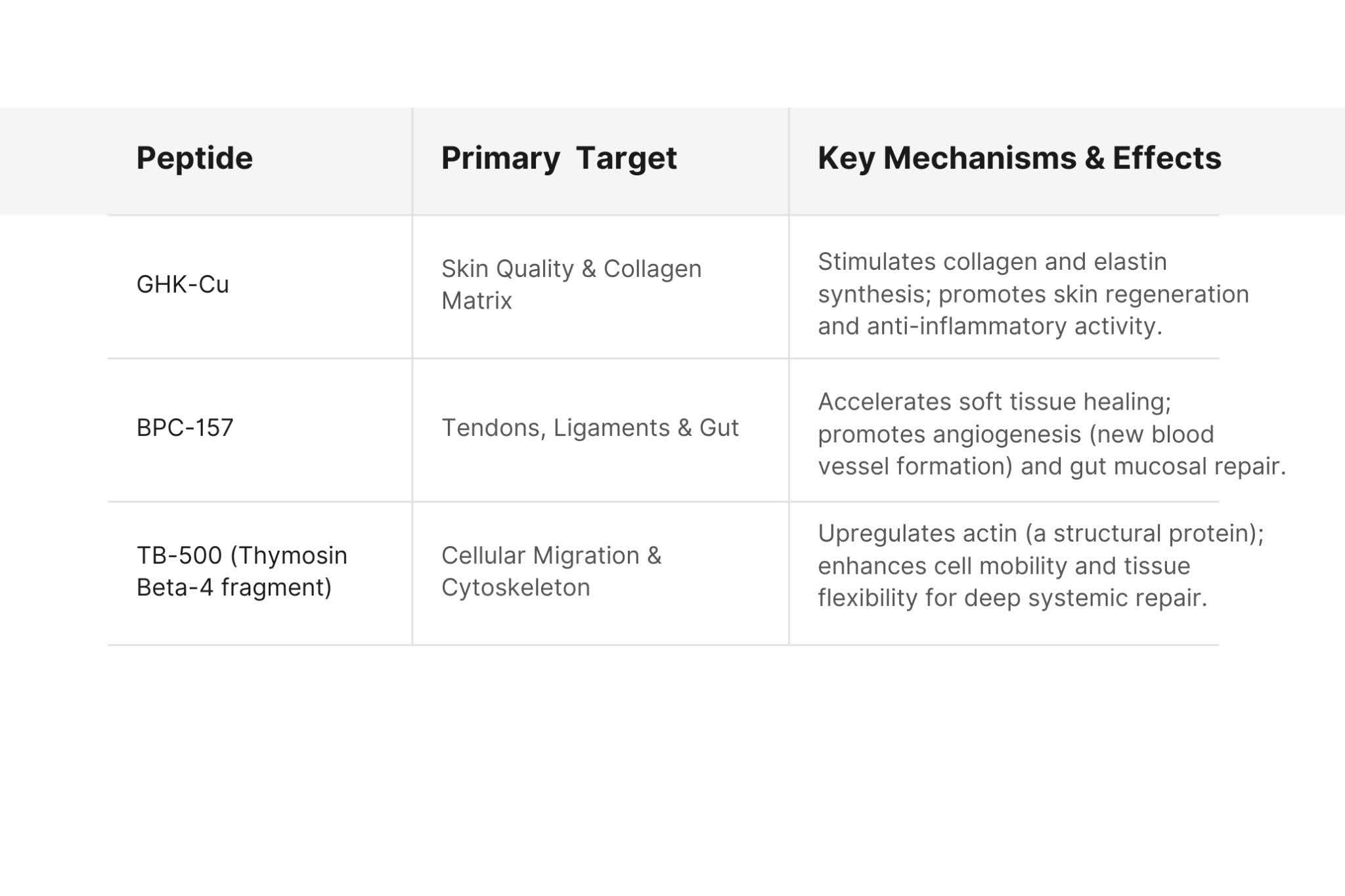
Each peptide in the glow stack influences a different system, but TB-500 is unique in that it adds an extra dimension by focusing on structural organization and cellular mobility. Scientists speculate that combining the three peptides—GHK-Cu, for extracellular matrix signaling; BPC-157, for vascular communication; and TB-500, for cytoskeletal dynamics—might yield a more comprehensive model for investigating how cells coordinate remodeling processes, although research on the combined stack is still largely theoretical when compared to single-peptide studies.12
These peptides don’t act independently; their biological pathways naturally overlap. Studying the multiple signaling systems at the same time allows research groups to investigate the interactions in more detail than they’d be able to when just using one peptide on its own.12
Summary of the Peptides in the Glow Stack
Quality Matters in Research Peptides
Credible scientific research is founded on quality materials, regardless of what peptide is being investigated. Analytical verification is crucial to ensure consistent, repeatable results.
Research-quality peptides are evaluated using:13
- Batch-specific Certificates of Analysis (COAs)
- High-performance liquid chromatography (HPLC) for purity analysis
- Sterility and quality-control screening
- Mass spectrometry (MS) for identity confirmation
- Endotoxin testing
Licensed Peptides’ research molecules are made in the USA under strict quality standards, including analytical verification demonstrating 99% purity, batch-specific laboratory reports, and endotoxin testing (see our endotoxin reports here). This level of quality helps researchers be assured of the consistency of the materials they are using.
Read our guide to find out more about how peptides are purified.
FAQs
Are Copper Peptide Creams the Same as GHK-Cu Research Peptides?
No, they are not the same. Both have the same core tripeptide sequence, but cosmetic copper-peptide creams and lab-grade GHK-Cu differ in four key areas:6
- Their Formulation: Cosmetic formulations combine low concentrations (0.05%–2%) with carriers and preservatives to form emulsions, creams, or serums, that can be safely absorbed by the skin; research peptides are raw and highly concentrated (98%+ pure) lyophilized (freeze-dried) cake/powder or liquid solutions designed for lab dilution.
- Purpose: They differ in purpose, purity, and regulation.
- Quality and Testing: Lab peptides undergo strict mass spectrometry (measuring the mass of molecules to confirm a compound’s identity) as well as HPLC testing to confirm a chemical’s purity and identity. Skincare undergoes skin-patch safety, heavy metal limit testing, microbial safety checks, and shelf-life stability testing.
- Legal Status: Cosmetic creams are regulated under commercial frameworks, such as the FDA, for use on human skin; research peptides are unapproved laboratory reagents classified as “not for human consumption.”
For more information on research peptides, read our guide: What are research peptides?
Do Peptides Function Like Anabolic Steroids?
No, because even though both can influence tissue growth, metabolism, and repair, they belong to completely different chemical classes.
Their chemical structure and mechanisms of action are primarily different.14
- Peptides are biological signaling molecules comprised of amino acids
- Anabolic steroids are synthetic derivatives of steroid hormones.
Do All Peptide Blends Have Identical Formulations?
No, they do not. The wording used in the field of peptide research is sometimes informal, and names like “glow stack” and “recovery blend” that are often used to describe combinations do not represent a standard pharmaceutical formula.
For example, the term Glow Stack usually denotes a blend of GHK-Cu, BPC-157, and TB-500; however, the actual product can vary dramatically between vendors.15
As a result, researchers must ensure they verify product identity, batch-specific analytical documentation, and purity before using materials in lab studies.
At Licensed Peptides, we use third-party HPLC (Purity) and MS (Mass Spectrometry) testing to confirm the purity and consistency of our products.
Conclusion
In conclusion, combining GHK-Cu, BPC-157, and TB-500 has provided researchers with a valuable tool for studying collagen production, tissue repair, cellular communication, and extracellular matrix remodeling, provided high-quality research materials are used.
As research continues, scientists hope to better understand how the peptides in the GLOW blend work together and how they can potentially contribute to the body’s natural healing processes, expanding our understanding of regenerative biology.
References
- Gerriets V, Babu R, Patel B. Biochemistry, peptide. In: StatPearls [Internet]. StatPearls Publishing; 2023. Accessed July 29, 2026.
- Pickart L. The human tri-peptide GHK and tissue remodeling. J Biomater Sci Polym Ed. 2008;19(8):969-988.
- McGuire F, Hughes E, Maak T, Cushman DM. Thymosin beta-4 and TB-500 in tissue healing, regeneration, and musculoskeletal repair: a scoping review. Phys Sportsmed. Published online June 19, 2026.
- Oliva A, Llabrés M, Fariña JB. Application of a validated stability-indicating chromatographic method to evaluate the reproducibility between batches of small peptides in solution. Anal Chim Acta. 2010;675(1):83-90.
- Sewald K, Jakubke HD. Peptides: chemistry and biology. In: Ullmann’s Encyclopedia of Industrial Chemistry. Wiley-VCH; 2002.
- Pickart L, Margolina A. Regenerative and protective actions of the GHK-Cu peptide in the light of the new gene data. Int J Mol Sci. 2018;19(7):1987.
- Maquart FX, Pickart L, Laurent M, Gillery P, Monboisse JC, Borel JP. Stimulation of collagen synthesis in fibroblast cultures by the tripeptide-copper complex glycyl-L-histidyl-L-lysine-Cu2+. FEBS Lett. 1988;238(2):343-346.
- Brcic L, Brcic I, Staresinic M, Novinscak T, Sikiric P, Seiwerth S. Modulatory effect of gastric pentadecapeptide BPC 157 on angiogenesis in muscle and tendon healing. J Physiol Pharmacol. 2009;60(suppl 7):191-196.
- Sikiric P, Seiwerth S, Rucman R, Turkovic B, Stancic Rokotov D, Brcic L. Stable gastric pentadecapeptide BPC 157: novel therapy in gastrointestinal tract. Curr Pharm Des. 2011;17(16):1612-1632.
- Hsieh MJ, Liu HT, Wang CN, et al. Therapeutic potential of pro-angiogenic BPC157 is associated with VEGFR2 activation and up-regulation. J Mol Med (Berl). 2017;95(3):323-333.
- Goldstein AL, Hannappel E, Kleinman HK. Thymosin beta4: actin-sequestering protein moonlights to repair injured tissues. Trends Mol Med. 2005;11(9):421-429.
- Rahman OF, Lee SJ, Seeds WA. Therapeutic peptides in orthopaedics: applications, challenges, and future directions. JAAOS Glob Res Rev. 2026;10(1):e25.00123.
- Mant CT, Chen Y, Yan Z, et al. HPLC analysis and purification of peptides. Methods Mol Biol. 2007;386:3-55.
- Nussey S, Whitehead S. Endocrinology: An Integrated Approach. BIOS Scientific Publishers; 2001.
- Høj LJ, Rasmussen BS, Dalsgaard PW, Linnet K. Analysis of seized peptide and protein-based doping agents using four complimentary methods: liquid chromatography coupled with time of flight mass spectrometry, liquid chromatography-ultraviolet, Bradford, and immunoassays. Drug Test Anal. 2021;13(7):1457-1463.

