What Is 5-Amino-1MQ? A Scientific Guide

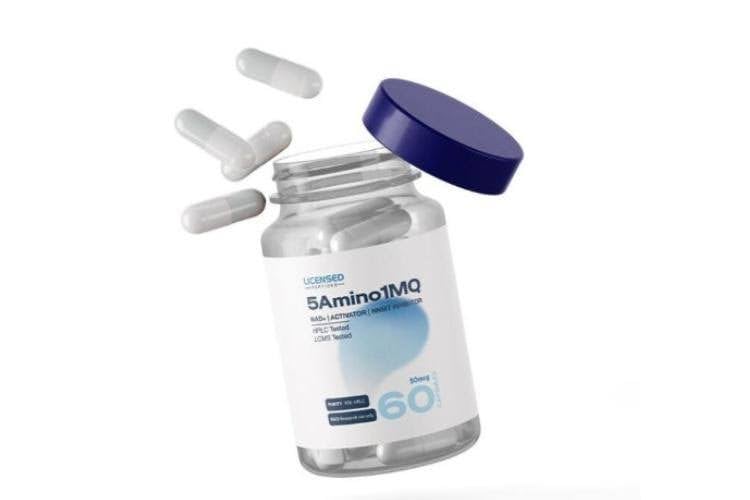
Research regarding energy production, mitochondrial function, and cellular metabolism has advanced greatly in recent years, and 5-Amino-1MQ has gained significant attention in the process. And while it’s often sold along with research peptides, it’s technically a small-molecule inhibitor of nicotinamide N-methyltransferase (NNMT), an enzyme. This unique structure of 5-Amino-1MQ makes it a valuable compound in the research of metabolic pathways, cellular energy, and NAD+ biology.1
Pre-clinical research focuses on how NNMT inhibition affects fat storage and oxidation, fat cell metabolism, and general mitochondrial health because NNMT moderates metabolism and methylation (how cells use methyl groups). Because this research is in the experimental stage, to produce reliable data that’s also reproducible, it’s essential that high-purity research materials are used.1
This guide discusses how 5-Amino-1MQ functions at a cellular level, the role it plays in modern research, and how it differs from peptides.
USA-manufactured research compounds are for laboratory use only and not for human consumption, clinical use, or diagnostic purposes. This guide is intended to support scientific research, and all products manufactured by Licensed Peptides are intended for research, laboratory, or analytical purposes only.
Is 5-Amino-1MQ a Peptide?
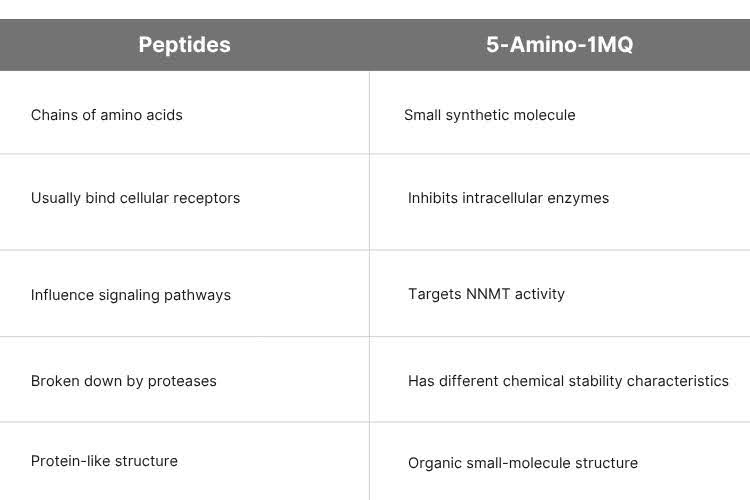
No. Peptides are short chains of amino acids joined by peptide bonds, and they work mainly as signalling molecules — binding receptors involved in hormone pathways, metabolic regulation, immune communication and tissue biology.2,3
5-Amino-1MQ contains no amino acids. It is a synthetic small molecule, and it is grouped with research peptides by convention rather than by chemistry. The distinction matters in practice: small molecules and peptides differ in how they are dissolved, stored and handled, and in how they interact with biological systems.3,5
For background on the peptide side of that comparison, see our Introduction to Peptides.
What Is 5-Amino-1MQ?
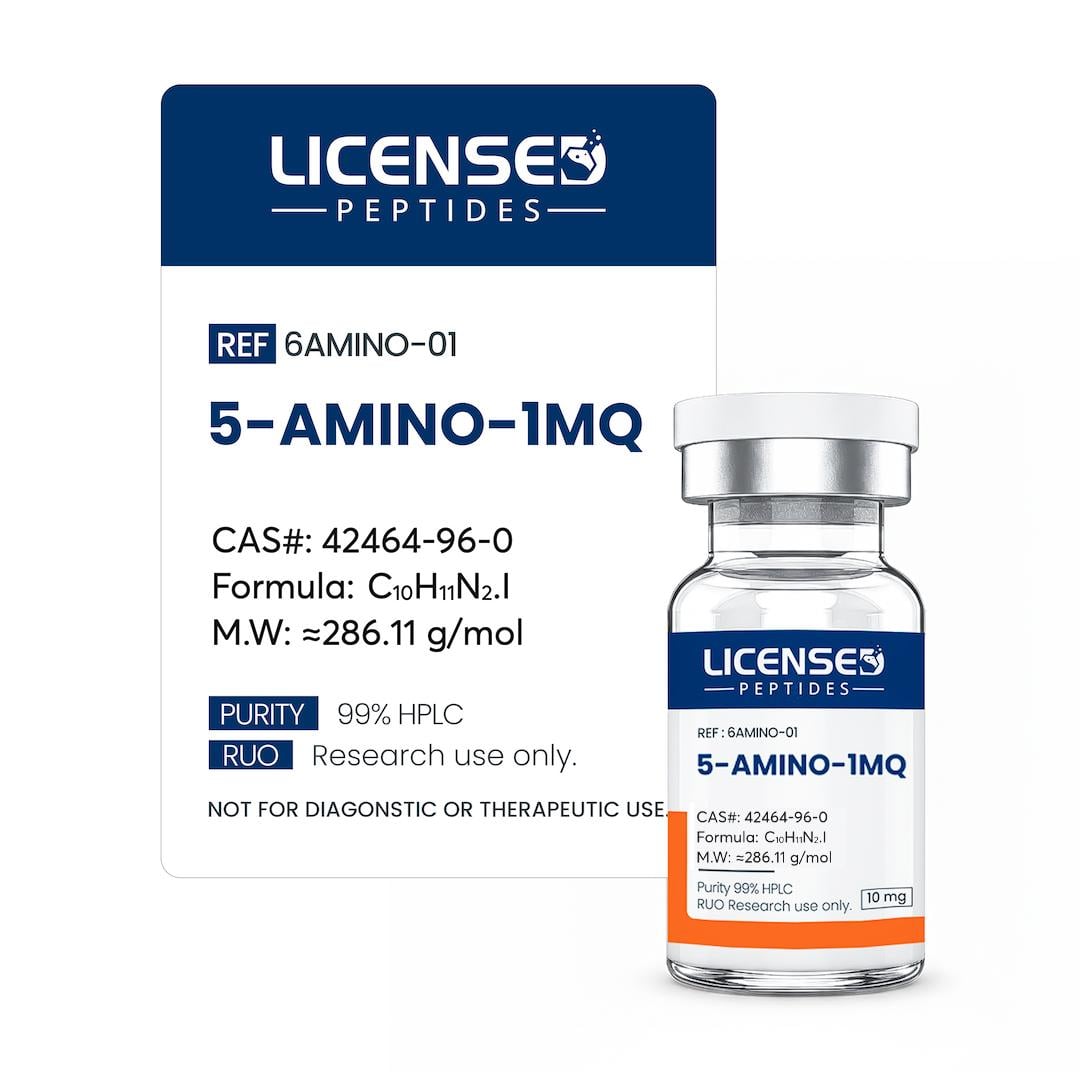
The full name of 5-Amino-1MQ is 5-amino-1-methylquinolinium, and, unlike a peptide, it’s not made from amino acids; rather, it’s a chemically synthesized compound created to block NNMT.1
NNMT produces 1-methylnicotinamide (MNA) by transferring a methyl group to nicotinamide, which shapes important biochemical systems, such as:1
- Cellular methylation and stress responses
- Metabolic pathways
- NAD+ metabolism and cellular energy
NNMT uses up nicotinamide, and high enzyme activity can reduce the amount left for the NAD+ salvage pathway, which recycles nicotinamide into fresh NAD+. By inhibiting NNMT, 5-Amino-1MQ helps cells preserve nicotinamide, changing how they process energy. Researchers classify 5-Amino-1MQ as an enzyme inhibitor, not a peptide, because of this process.1
Why Researchers Study NNMT
Researchers study NNMT because its expression differs sharply from tissue to tissue. It is a cytosolic enzyme that transfers a methyl group from S-adenosyl-L-methionine to nicotinamide and related substrates, and while the liver carries the highest levels, it is also present in adipose tissue, kidney, brain, lung, heart and skeletal muscle.18,22 Elevated expression has been reported in several chronic disease contexts, which is part of why the enzyme became a target for selective inhibitors.4 Studies have observed it to be especially active in:4
- Skeletal muscle
- Connective tissue
- Adipocytes (fat cells)
- Liver tissue
- Certain immune cells
Due to this activity, NNMT is of interest to scientists when examining:4
- Mitochondrial health
- Fat cell metabolism
- Cellular aging and metabolism
- Metabolic pathways
- Energy expenditure
The evidence to date indicates that NNMT impacts nicotinamide recycling and how cells balance methyl donor availability, and experts continue to use experimental models to determine how these processes might be involved in changes in fat mass, body composition, and visceral adipose tissue; however, the findings are still limited to lab research.4
Small Molecules Vs. Peptides
Both small molecules and peptides are valuable tools in lab-based research even though they differ substantially. When selecting research materials, researchers should keep this in mind as these differences can affect the stability, handling, and design of the materials.5
How 5-Amino-1MQ Works at the Cellular Level
It’s important to distinguish between outcomes observed in a lab and established biological ones when considering the possible benefits of 5-Amino-1MQ.
Current research primarily comes from animal studies and cell cultures, which provide valuable insight into how NNMT inhibition might affect cellular and energy metabolism, as well as the related biochemical pathways; however, they do not establish the effects in humans.4-6
5-Amino-1MQ’s inhibition of NNMT impacts interconnected metabolic networks, including methyl donor utilization, nicotinamide recycling, and NAD+ availability, so research teams are actively investigating if it influences:4-6
- Cellular function and energy
- Energy production
- Fat oxidation and fat storage
- Fat cell metabolism
- Mitochondrial function
- Metabolic health
The Relationship Between NNMT and NAD+

Another important element when it comes to understanding 5-Amino-1MQ is NAD+.
NAD+ is a coenzyme that’s present in almost every living cell. It’s also a participant in hundreds of enzymatic reactions involving:7
- Cellular signaling
- Adenosine triphosphate (ATP) production (ATP is the primary energy source for cellular functions)
- DNA repair
- Mitochondrial function
- Oxidation-reduction (redox) reactions
There’s a constant cycle of cells consuming and recycling NAD+, and one of the main recycling mechanisms is the NAD+ salvage pathway, which changes nicotinamide back into available NAD+. Because NNMT is also competing for nicotinamide, the increase in enzyme activity may reduce what’s available for recycling. Therefore, by impeding NNMT activity, research teams speculate that there’ll be more nicotinamide available for the salvage pathway.7
Furthermore, NNMT transfers a methyl group from S-adenosylmethionine (SAM), the cell’s universal methyl donor, and changes it into S-adenosylhomocysteine (SAH). By inhibiting NNMT, 5-Amino-1MQ helps preserve both the salvage pool and SAM availability, supporting overall cellular methylation balance with energy metabolism.1,15 Researchers call the reverse case — high NNMT activity drawing down the methyl-donor pool — the SAM-depletion mechanism, and it is a focus of metabolic and epigenetic research in its own right.15
Why NAD+ and Mitochondrial Function Matter
Maintaining enough NAD+ is crucial because it activates several important processes, including:7
- Cellular signaling and metabolic regulation
- Cellular energy production and oxidative metabolism
- DNA repair enzymes and sirtuin (proteins that protect and repair) activity
Mitochondria need a constant supply of NAD+ to make ATP. In research models, 5-Amino-1MQ helps maintain NAD+ pools by stopping nicotinamide from being wasted, which keeps cellular energy pathways running properly. Even though research to date remains preclinical, this mechanism is what makes 5-Amino-1MQ such a point of focus in cellular metabolism research.7
5-Amino-1MQ: The “Cell Shrinker” and Adipocyte Modulator
A popular aspect of 5-Amino-1MQ research is its impact on adipocytes (fat cells), which has led some scientists to refer to it as a “cell shrinker.” Adipocytes are responsible for moderating cellular signaling, energy storage, and fat cell metabolism while simultaneously engaging with the surrounding tissue.1
Research teams are analyzing whether, by blocking NNMT, there’s a change in how fat cells operate, particularly in how they manage energy. Preclinical research suggests that inhibiting NNMT impacts nicotinamide recycling as well as NAD+ availability, methylation balance, and mitochondrial activity.1 The stored lipids aren’t broken down directly; the fat cell’s internal metabolic environment is modified.
While these findings provide great insight into cellular energy management, it’s important to note that they are strictly part of laboratory studies and don’t indicate changes in fat mass or human body composition.
Fat Cell Metabolism Is More Than Fat Storage
Fat cells do much more than store excess lipids; they are constantly responding to alterations in cellular energy demands and nutrient availability. The mitochondria in adipocytes assist in coordinating essential processes that keep cells working effectively, such as:4
- Cellular Stress Responses: Mitochondria help cells adjust to environmental changes by responding to oxidative and metabolic stress, which helps maintain normal cellular processes.
- ATP Production: Mitochondria produce ATP, the main source of energy that powers cellular activity and supports overall function.
- Oxidative Metabolism: Mitochondria change nutrients into usable cellular energy through biochemical reactions.
- Lipid Metabolism: Mitochondria help modulate how fats are processed, used, and stored within cells.
- Redox Balance: Mitochondria play an important role in keeping a balance between antioxidants and oxidants.
Research to date indicates that a reduction in NNMT activity can change the gene expression in fat metabolism, cellular respiration, and mitochondrial activity; in fact, it influences multiple interconnected elements of cellular metabolism, which is why researchers are interested in how 5-Amino-1MQ and its inhibition of NNMT influence this broad metabolic network. This is also why adipose tissue continues to be an important objective of metabolic research.4
Visceral Adipose Tissue
Another area of research is NNMT activity in visceral fat (adipose) tissue (fat around internal organs) because it’s different from subcutaneous fat in terms of its metabolic traits and cell type. Pre-clinical studies show that NNMT levels differ between fat stores; more research into enzyme activity across different fat cell populations is needed.8
Again, it’s important to note that these studies are in the exploratory stage.
The MOTS-C Connection

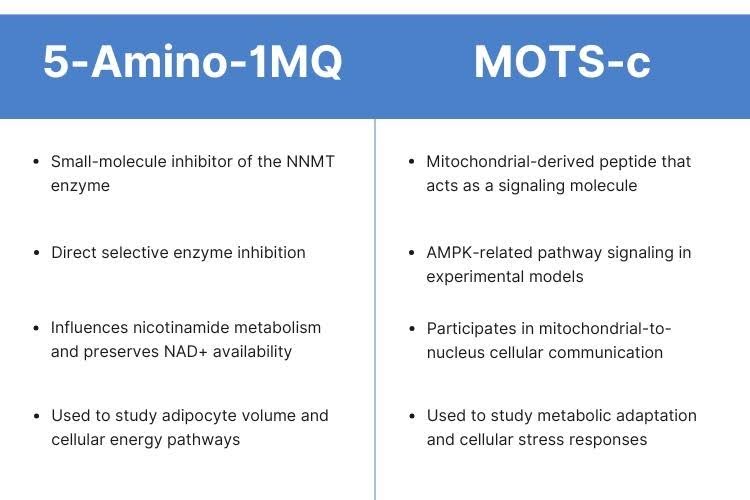
MOTS-C and 5-Amino-1MQ are fundamentally different; however, they are often studied together because they both engage with cellular processes associated with metabolic regulation, energy metabolism, and mitochondrial function. As we know, 5-Amino-1MQ is a small-molecule NNMT inhibitor, while MOTS-C is a mitochondrial-derived peptide.
What Is MOTS-C?
MOTS-C is a naturally occurring peptide that’s encoded by mitochondrial DNA. Unlike most proteins that are encoded in a cell’s nucleus, MOTS-C comes from the mitochondria, which are the organelles responsible for most of a cell’s energy production.9-10
MOTS-C’s precise mechanism is still being investigated, but researchers hypothesize that it influences pathways that assist cells in responding to changing energy demands. Lab studies indicate MOTS-C may be involved in:9-10
- Mitochondrial communication
- Cellular energy regulation
- Metabolic adaptation
- Nutrient sensing
- Cellular stress responses
MOTS-C and 5-Amino-1MQ: A Quick Look at the Differences & Similarities
Both compounds are being researched for their roles in:9-10
- Mitochondrial health
- Energy and cellular metabolism
- Supporting mitochondrial function
- Cellular stress adaptation
AMPK and Cellular Energy
MOTS-C also has a relationship with AMP-activated protein kinase (AMPK), which is often called the cell’s energy sensor. When cellular energy is limited, AMPK helps by coordinating metabolic adjustments and influencing the pathways involved in fatty acid oxidation, ATP production, the use of glucose, and mitochondrial activity.11
5-Amino-1MQ does not directly activate AMPK; however, research teams want to know whether changes in NAD+ metabolism after NNMT inhibition indirectly impact associated cellular energy networks.11
What Does the Preclinical Evidence Actually Show?
The literature on 5-Amino-1MQ is small, recent and entirely preclinical. Four studies do most of the work, and it is worth being precise about what each one reported.
The 2014 Study That Made NNMT a Target
Before any inhibitor existed, a knockdown study established that NNMT sits at the junction of two systems: NAD+ regeneration through nicotinamide recycling, and SAM-dependent methylation. Knocking the enzyme down in adipose tissue protected mice against diet-induced obesity.4 That result is the reason selective NNMT inhibitors were developed at all.
The 2018 Study of 5-Amino-1MQ in Diet-Induced Obese Mice
The first study to test 5-Amino-1MQ directly confirmed that the compound inhibits NNMT and is membrane-permeable, then measured metabolic outcomes in mice on a high-fat diet.1 Reported observations included smaller adipocytes, lower total adipose tissue mass, a reduction in plasma total cholesterol of roughly 30% versus untreated controls, and suppressed lipogenesis in treated adipocytes22. Body weight fell modestly, and critically, food intake did not change — which is what pointed researchers toward altered energy handling rather than appetite suppression as the mechanism at work in the model.1,17
The same body of work reported that NNMT activity is far higher in mature adipocytes than in precursor cells, and that intracellular NAD+ and SAM pools rose in treated fat cells.1
The 2019 Muscle Stem Cell Study
A separate line of work looked at skeletal muscle rather than fat. Muscle repair depends on satellite cells (muscle stem cells), whose proliferation and differentiation decline with age. In aged animals, NNMT inhibition increased satellite cell proliferation and fusion, produced larger myofiber cross-sectional areas after injury, and improved contractile function, with peak torque in regenerating muscle roughly 70% higher than in controls.6 Later work reported that NNMT inhibition both mimicked and added to exercise-driven improvements in muscle function in aged mice.16
The Only Dedicated Pharmacokinetic Study
One published study developed and validated an LC-MS/MS assay for 5-Amino-1MQ in rat plasma and used it to characterise plasma concentrations, tissue distribution, elimination and oral bioavailability.21 It found that the compound reaches tissues where NNMT is expressed, which is the practical reason it remains usable as a research tool. No human pharmacokinetic data has been published.
NNMT Inhibition Alongside Calorie Restriction
Exploratory work has combined NNMT inhibition with a reduced-calorie diet in obese mice and reported a distinct gut microbiome signature in the combined condition, with both interventions touching lipid metabolism, NAD+ metabolism and mitochondrial function.20 This remains an early-stage line of inquiry.
What Do Researchers Measure in These Experiments?
Because energy metabolism, methylation and NAD+ biology are interlinked, studies read several markers rather than one:7
- NAD+ concentrations and nicotinamide metabolites, including 1-methylnicotinamide (MNA)
- ATP production and oxygen consumption
- Lipid metabolism markers and adipocyte size
- Gene expression for metabolic enzymes, mitochondrial activity and fat-cell signalling
- Tissue weight, fat mass and lean tissue mass in animal models
Alongside activity, early-stage studies also track general condition, behaviour, food intake, blood chemistry and post-study tissue analysis to build a preliminary safety picture. Published work has generally described 5-Amino-1MQ as well tolerated under the specific conditions tested, with no significant changes in common liver or kidney markers, but that description belongs to short-term rodent studies and nothing more.1
What the Evidence Does Not Cover
There are no human clinical trials of 5-Amino-1MQ. Everything above comes from cell cultures and short-term rodent experiments. Long-term enzyme interaction, the downstream consequences of sustained NAD+ preservation, and tissue-specific differences in NNMT expression are all open questions.
Handling, Stability, and Storage Guidelines
Correct storage ensures research compounds remain reliable and stable, because exposure to heat, air, and light can destroy materials, even pure ones, which is why it’s imperative to check a product’s Certificate of Analysis (COA) before beginning a study.
The following protocols are required:12
- Preventing Freeze-Thaw Damage: Mixed solutions need to be split into aliquots (single-use smaller amounts), because repetitively freezing and thawing compounds breaks them down over time.
- Physical Form: 5-Amino-1MQ comes in the form of a lyophilized (freeze-dried) powder or solid block, which protects it from water breakdown during shipping. Stored samples need to be kept away from heat, humidity, and direct light.
- Solubility & Mixing: 5-Amino-1MQ dissolves differently to synthetic peptides because it’s a small molecule; therefore, it should be mixed according to verified small-molecule protocols. Once it’s mixed into a solution, it deteriorates faster than dry powder, so only what is needed for immediate testing should be made.
- Storage Temperatures:
- A Refrigerator (2°C to 8°C): Best for short-term storage.
- An Ultra-Low Freezer (-80°C): Ideal for long-term storage to prevent oxidation and deterioration.
- A Standard Freezer (-20°C): Recommended for dry powder storage for the medium- to long-term.
To find out more about proper storage, read our guide: How to Properly Store Peptides.

[Photo by Pixelshot, Canva].
FAQs
Where Do You Get Quality 5-Amino-1MQ for Research?
Research-grade compounds should be sourced from suppliers that provide:13
- Batch-specific Certificates of Analysis (COAs)
- 99%+ purity verified via analytical testing
- Endotoxin testing
- Third-party analytical verification
- Confirmation of identity utilizing validated analytical methods
Licensed Peptides’ compounds are manufactured according to rigorous standards regarding storage, purity, and endotoxin testing. Each batch is analytically verified, and batch-specific reports are provided, as well as a Certificate of Analysis (COA).
Beyond this analytical quality, Licensed Peptides also offers:
- Same-day shipping on qualifying orders
- USA-made research compounds
- Live phone support from informed representatives
- Research materials intended exclusively for laboratory applications
These protocols ensure researchers get consistent materials to enable reproducible experimental research.
How Is 5-Amino-1MQ Different From an NAD+ Precursor?
They approach the same pool from opposite directions. NAD+ precursors add substrate to the salvage pathway. 5-Amino-1MQ instead removes a competing drain on it: NNMT converts nicotinamide into MNA, so inhibiting the enzyme leaves more nicotinamide available for recycling and spares S-adenosylmethionine at the same time.1,7 Whether that indirect route produces comparable downstream changes is one of the questions the current studies are designed to test.
Does 5-Amino-1MQ Activate AMPK?
Not directly. AMPK is the cell’s energy sensor and is activated by peptides such as MOTS-C. 5-Amino-1MQ has no direct action on it; the open research question is whether shifting NAD+ metabolism through NNMT inhibition affects AMPK-linked energy networks indirectly.11
Does 5-Amino-1MQ Have to Be Refrigerated?
How a compound is stored depends on its physical form and, of course, the manufacturer’s guidelines.
Dry research compounds are generally more chemically stable than prepared aqueous solutions, which are often more susceptible to degradation during storage, and they often need to be refrigerated for short-term use or frozen for long-term use.14
The manufacturer’s storage protocol and the accompanying Certificate of Analysis should be followed to help maintain a compound’s integrity and ensure the research results are reliable.
Is 5-Amino-1MQ Administered Via Injection or Orally?
In laboratory research, 5-Amino-1MQ has been studied using both injection and oral administration; the route of administration is dependent on the purpose of the research and the experimental model.1
Some studies evaluate the oral compound to analyze how it’s absorbed, metabolized, and distributed. This method can assist researchers in understanding how the compound acts under oral-exposure conditions.1
Other studies evaluate injectable administration, typically with intraperitoneal (IP) injections in animal models. Injections enable research teams to use a controlled amount of the compound, which makes it easier to study pharmacokinetics and biological activity.1
Different administration routes might produce different pharmacokinetic profiles, which is why research teams usually choose the method that best aligns with the goals of the experiment.1
It is important to note that 5-Amino-1MQ is a research compound only. It is not approved for human use, and there are no established or recommended routes of administration for people. Any discussion of oral or injectable administration relates exclusively to controlled laboratory research.
Conclusion
Understanding what 5-Amino-1MQ is starts with recognizing the important role it plays in the research of cellular metabolism.
By blocking NNMT, 5-Amino-1MQ gives researchers a way to investigate how this inhibition impacts NAD+ preservation, nicotinamide recycling, and the complex network that supports everything from cellular energy and energy production to metabolic pathways and mitochondrial function. Researchers are continuing to examine its interaction with broad elements of metabolic health, including fat oxidation and storage, as well as fat cell metabolism.
Furthermore, the quality of the research materials is crucial as reliable outcomes depend on the compounds being suitably manufactured and independently verified.
At Licensed Peptides, we support researchers with 99%+ purity-verified research compounds manufactured under strict quality controls.
Note: All products are sold for research, lab, or analytical purposes only and are not for human consumption.
References
- Neelakantan H, Vance V, Wetzel MD, et al. Selective and membrane-permeable small molecule inhibitors of nicotinamide N-methyltransferase reverse high fat diet-induced obesity in mice. Biochem Pharmacol. 2018;147:141-152.
- Fosgerau K, Hoffmann T. Peptide therapeutics: current status and future directions. Drug Discov Today. 2015;20(1):122-128.
- Lau JL, Dunn MK. Therapeutic peptides: historical perspectives, current development trends, and future directions. Bioorg Med Chem. 2018;26(10):2700-2707.
- Kraus D, Yang Q, Kong D, et al. Nicotinamide N-methyltransferase knockdown protects against diet-induced obesity. Nature. 2014;508(7495):258-262.
- Gare CL, White AM, Malins LR. From lead to market: chemical approaches to transform peptides into therapeutics. Trends Biochem Sci. 2025;50(6):467-480.
- Neelakantan H, Brightwell CR, Graber TG, et al. Small molecule nicotinamide N-methyltransferase inhibitor activates senescent muscle stem cells and improves regenerative capacity of aged skeletal muscle. Biochem Pharmacol. 2019;163:481-492.
- Park J, Shin EJ, Kim TH, et al. Exploring NNMT: from metabolic pathways to therapeutic targets. Arch Pharm Res. 2024;47(12):893-913.
- Hong S, Moreno-Navarrete JM, Wei X, et al. Nicotinamide N-methyltransferase regulates hepatic nutrient metabolism through Sirt1 protein stabilization. Nat Med. 2015;21(8):887-894.
- Zheng Y, Wei Z, Wang T. MOTS-c: a promising mitochondrial-derived peptide for therapeutic exploitation. Front Endocrinol (Lausanne). 2023;14:1120533.
- Jiang J, Xu L, Yang L, Liu S, Wang Z. Mitochondrial-derived peptide MOTS-c ameliorates spared nerve injury-induced neuropathic pain in mice via the AMPK pathway. ACS Chem Neurosci. 2023;14(12):2362-2374.
- Lee C, Zeng J, Drew BG, et al. The mitochondrial-derived peptide MOTS-c promotes metabolic homeostasis and reduces obesity and insulin resistance. Cell Metab. 2015;21(3):443-454.
- Baertschi SW, Jansen PJ, Alsante KM, eds. Pharmaceutical Stress Testing: Predicting Drug Degradation. 2nd ed. CRC Press; 2011.
- US Food and Drug Administration. Analytical Procedures and Methods Validation for Drugs and Biologics: Guidance for Industry. US Dept of Health and Human Services, Center for Drug Evaluation and Research; 2015.
- International Council for Harmonisation of Technical Requirements for Pharmaceuticals for Human Use. ICH Q1A(R2): Stability Testing of New Drug Substances and Products. ICH; 2003.
- Ulanovskaya OA, Zuhl AM, Cravatt BF. NNMT promotes epigenetic remodeling in cancer by creating a metabolic methylation sink. Nat Chem Biol. 2013;9(5):300-306. doi:10.1038/nchembio.1204
- Dimet-Wiley AL, Latham CM, Brightwell CR, et al. Nicotinamide N-methyltransferase inhibition mimics and boosts exercise-mediated improvements in muscle function in aged mice. Sci Rep. 2024;14(1):15554. doi:10.1038/s41598-024-66034-9
- Sun WD, Zhu XJ, Li JJ, et al. Nicotinamide N-methyltransferase (NNMT): a novel therapeutic target for metabolic syndrome. Front Pharmacol. 2024;15:1410479. doi:10.3389/fphar.2024.1410479
- Roberti A, Fernández AF, Fraga MF. Nicotinamide N-methyltransferase: at the crossroads between cellular metabolism and epigenetic regulation. Mol Metab. 2021;45:101165. doi:10.1016/j.molmet.2021.101165
- Babula JJ, Bui D, Stevenson HL, Watowich SJ, Neelakantan H. Nicotinamide N-methyltransferase inhibition mitigates obesity-related metabolic dysfunction. Diabetes Obes Metab. 2024;26(11):5272-5282. doi:10.1111/dom.15879
- Dimet-Wiley A, Wu Q, Wiley JT, et al. Reduced calorie diet combined with NNMT inhibition establishes a distinct microbiome in DIO mice. Sci Rep. 2022;12(1):484. doi:10.1038/s41598-021-04149-z
- Awosemo O, Neelakantan H, Watowich S, et al. Development and validation of LC-MS/MS assay for 5-amino-1-methyl quinolinium in rat plasma: application to pharmacokinetic and oral bioavailability studies. J Pharm Biomed Anal. 2021;204:114255. doi:10.1016/j.jpba.2021.114255
- Kannt A, Rajagopal S, Kadnur SV, et al. A small molecule inhibitor of nicotinamide N-methyltransferase for the treatment of metabolic disorders. Sci Rep. 2018;8:3660. doi:10.1038/s41598-018-22081-7

