Need help? Call Or Text us, and a team member will be happy to assist you. +1 (855) 322-2214
Need help? Call Or Text us, and a team member will be happy to assist you. +1 (855) 322-2214
5-Amino-1MQ Benefits: Exploring the Research

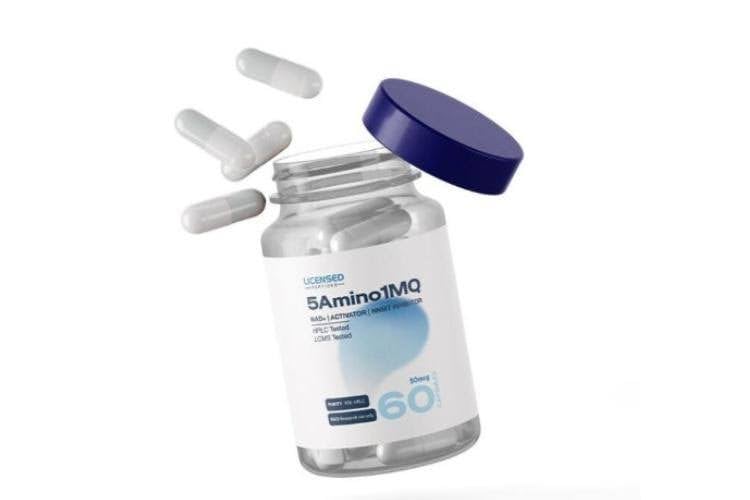
The compound 5-amino-1MQ has gained increasing attention over the past decade as researchers investigate how cellular enzymes moderate energy production, metabolic pathways, and the use of nutrients. It’s a synthetic small-molecule inhibitor created to target an enzyme associated with methylation and nicotinamide metabolism called Nicotinamide N-methyltransferase (NNMT).1
Instead of acting on signaling peptides or hormone receptors, 5-amino-1MQ selectively inhibits NNMT, so scientists use it to examine how changes in NNMT activity affect metabolic pathways associated with metabolism, cellular energy, body composition, and overall metabolic function in lab models.1
Although discussions regarding 5-amino-1MQ’s benefits have become more common, it’s important to note that findings are primarily from preclinical studies; it has not been approved for clinical or medical use.
Furthermore, USA-made synthetic compounds are for lab use only and not for human consumption, clinical use, or diagnosis.
What Is 5-Amino-1MQ?
5-Amino-1MQ stands for 5-amino-1-methylquinolinium, and as stated above, it inhibits NNMT, which is found in many tissues. This inhibition links the cell’s chemical regulation system with its energy-related metabolism.
Researchers became more interested in 5-amino-1MQ after studies showed that modifying NNMT might affect several biological processes; it’s essentially a research tool that helps scientists analyze how changes in enzyme activity influence wider metabolic networks.
How Does It Work?
When 5-amino-1MQ binds to the NNMT enzyme, it reduces its activity, which alters how cells process nicotinamide and methyl donors, the molecules that provide methyl groups to cells. Research suggests this action may influence biochemical processes further along the pathway.
Research teams are mostly interested in the following interconnected mechanisms:
NNMT and the SAM-Depletion Mechanism
NNMT acts like a chemical transfer tool; it transfers a small chemical group from one molecule, S-adenosyl-L-methionine (SAM), to another (nicotinamide), creating 1-methylnicotinamide (MNA) and S-adenosylhomocysteine (SAH).2
Researchers speculate that an increase in NNMT activity might reduce methyl donors’ availability for other pathways because SAM is essential for the methylation of:2
- DNA
- RNA
- Protein
- Lipid regulation
This notion is known as the SAM-depletion mechanism and is an area of focus in metabolic research.2
Mechanism of NNMT Inhibition by 5-Amino-1MQ
Preclinical research suggests that NNMT suppression may lead to:1
- Less SAM consumption
- Diminished production of MNA
- Modified metabolic signaling in experimental models
- More nicotinamide availability for NAD+ recycling
Because NNMT is the link between methylation and nicotinamide metabolism, research teams continue to examine how inhibiting it affects body composition, energy balance, and metabolic markers. This mechanism of action is what makes 5-amino-1MQ such a valuable research tool in the study of interconnected metabolic pathways and energy metabolism.1
The NAD+ Axis Connection
NAD+ (nicotinamide adenine dinucleotide) is a coenzyme that’s part of energy production, cellular energy, and supporting mitochondrial function, and the relationship between NNMT inhibition and the NAD+ salvage pathway is another significant area of research.3
Most NAD+ is regenerated via the salvage pathway, which recycles the nicotinamide back into NAD+.
Due to the fact that NNMT converts nicotinamide into MNA, scientists speculate that impeding NNMT potentially leaves more nicotinamide for NAD+ recycling.3
To find out more about NAD+, read our guide: The Impact of NAD+ Decline on Aging.
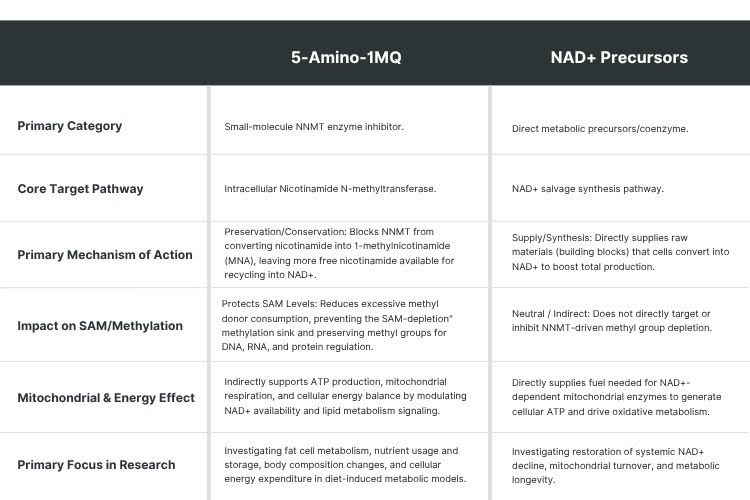
Comparison of Key Mechanisms: 5-Amino-1MQ vs. NAD+ Precursors
The following table compares the distinct mechanisms, research applications, and pathways of 5-Amino-1MQ versus NAD+ precursors.4
Primary Areas of Research and Benefits of 5-Amino-1MQ
Notably, even though there’s ample preclinical research to support the claims regarding 5-amino-1MQ, the interactions are still being investigated in lab models, and most findings come from animal models and cell-based studies.
Metabolic Health Research
One of the main areas of research regarding 5-amino-1MQ is metabolic health, and researchers are investigating how the inhibition of NNMT affects the wider network of biochemical reactions rather than simply focusing on one pathway.5
Small alterations in enzyme activity can affect multiple metabolic processes at the same time because the systems work together.
Currently, research teams are exploring how NNMT inhibition could change:5
- Energy metabolism
- Fat metabolism
- Cellular nutrient utilization
- Methylation balance
- Overall metabolism and body composition
- Nicotinamide recycling
These experiments help researchers understand how metabolism adjusts to changes in enzyme activity, providing further insight into cellular regulation.
Cellular Energy, Mitochondrial Function, and Bioenergetics
All living cells need a constant supply of energy to maintain homeostasis and perform basic biological processes. The main site where this energy conversion takes place is the mitochondrion, which is often called the powerhouse of the cell.3
Metabolic substrates derived from fats, carbohydrates, and proteins are oxidized in the mitochondria via cellular respiration to produce adenosine triphosphate (ATP), the main molecule that’s used to transfer and store chemical energy in cells.3
Because many important enzymes associated with mitochondrial respiration and ATP synthesis depend directly on NAD+, changes in NAD+ availability can considerably influence cellular bioenergetics. By selectively suppressing the NNMT enzyme, 5-amino-1MQ reduces the conversion of nicotinamide into MNA, potentially preserving free nicotinamide for the NAD+ salvage pathway. Consequently, scientists are investigating if changing nicotinamide metabolism in this way results in meaningful downstream changes in different tissue types.3
Beyond ATP generation, mitochondria play essential roles in metabolic signaling, intracellular calcium handling, and maintaining oxidative balance, a cell’s mechanism for managing reactive oxygen species (ROS) and cellular stress. Because these mitochondrial functions are closely linked to nutrient availability and enzyme regulation, researchers use 5-amino-1MQ in lab models to evaluate a wide spectrum of processes:6
- Mitochondrial Respiration & ATP Production: Measuring how efficiently mitochondria convert nutrients into ATP (cellular energy) by evaluating energy production and mitochondrial respiration.
- Metabolic Flexibility: Studying how cells adapt by switching between different energy sources, for example, glucose and fatty acids, when demands change.
- Oxidative Balance & Cellular Resilience: Examining how NAD+ levels and mitochondrial enzymes influence a cell’s ability to respond to different types of stress.
- Metabolic Pathway Regulation: Investigating how changes in important enzymes affect other metabolic processes, including NAD+-dependent reactions and general energy metabolism.
By studying these interconnected processes, researchers aim to gain a better understanding of how changes in NNMT activity impact cellular metabolic efficiency, energy production, and the ability of cells to adapt to changing energy demands.6
Fat Metabolism
Fat metabolism is the group of biochemical processes that govern breaking down fat (fat loss), fat storage, and using lipids in cells.1
Current studies around fat metabolism consider systems such as:7
- Cellular lipid utilization
- Lipid storage mechanisms
- Fatty acid oxidation (the breakdown of fatty acids for energy)
- Adipocyte (fat cell) metabolism
- Interactions between NAD+ biology and lipid metabolism
Scientists are studying this because research has shown that NNMT inhibition may play a role in influencing how cells control lipid metabolism by modifying the availability of intracellular energy and methylation-associated pathways. They’re also looking at whether these processes might influence how cells process fatty acids in controlled experiments.7
Some preclinical studies have noted changes in the lab models; however, more research is required to confirm the underlying mechanisms and to determine if similar responses transpire in other systems.
Body Composition Research
Lean tissue, fat, bone, and other components make up body composition, which some researchers study regarding its potential relationship with NNMT.
Scientists have used animal studies to determine whether modifying NNMT activity has an effect on body composition over time, under controlled conditions, measuring variables such as:1
- Tissue weight
- Fat mass
- Lean tissue mass
- Nutrient utilization
- Energy expenditure
Notably, these findings are specific to experimental models.1
Metabolic Markers
Metabolic markers are measurable biological indicators that demonstrate how cells regulate biochemical pathways and process nutrients. The measurements give research teams a more detailed idea of how exactly NNMT inhibition affects metabolism in laboratory environments. Because the interactions between energy metabolism, methylation, and NAD+ biology are so complex, to gain a better understanding, researchers consider multiple metabolic markers, rather than just looking at one.7
The markers researchers typically evaluate are:7
- Lipid metabolism markers
- Gene expression related to metabolic enzymes
- NAD+ concentrations
- ATP production
- Oxygen consumption
- Nicotinamide metabolites
- 1-Methylnicotinamide (MNA)

What the Pre-Clinical Research Shows
Although the findings are promising, 5-Amino-1MQ has not been evaluated in human clinical trials, so evidence to date should be interpreted accordingly.
The 2018 Pivotal Study: 5-Amino-1MQ in Diet-Induced Obese Mice
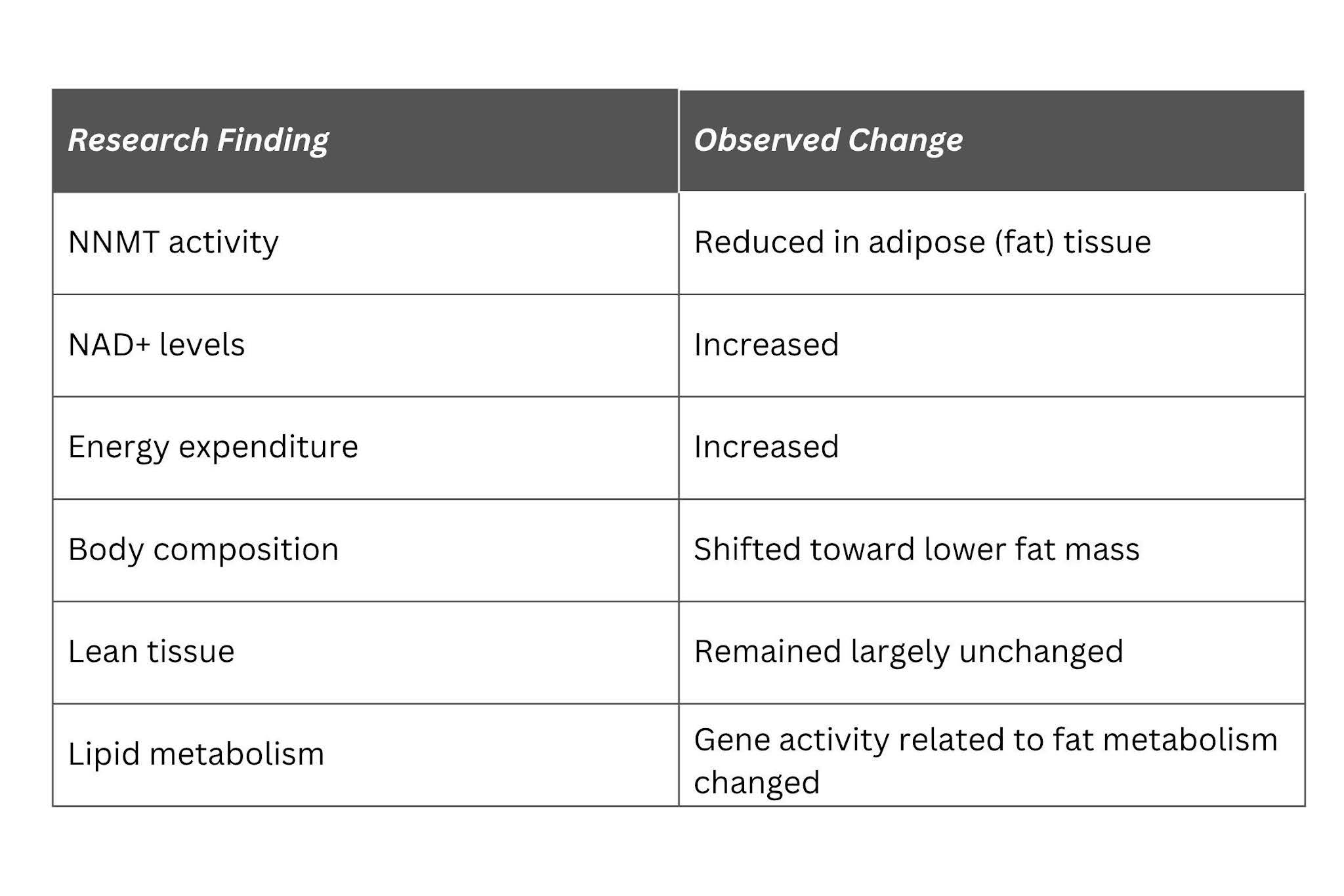
A 2018 study was the first to indicate that inhibiting NNMT with 5-amino-1MQ resulted in measurable metabolic changes in mice with diet-induced obesity.1 To further investigate these mechanisms, research teams first confirmed that 5-amino-1MQ efficiently inhibited the NNMT enzyme before they evaluated a range of metabolic results.
The trials demonstrated higher levels of markers linked to mitochondrial activity, showing that NNMT inhibition might affect how cells make energy and process fats in lab models.1
The 2014 Landmark Study
A 2014 study set the foundation for NNMT investigations.8 It didn’t investigate 5-amino-1MQ directly, but it showed that NNMT links two important metabolic systems: NAD+ production through nicotinamide recycling and SAM-dependent methylation, establishing NNMT as a key regulator of metabolic pathways and supporting the development of selective inhibitors such as 5-amino-1MQ.8
5-Amino-1MQ Combined With Calorie Restriction
In preclinical research, it was found that both 5-amino-1MQ and calorie restriction impact pathways related to:9
- Lipid metabolism
- NAD+ metabolism
- Mitochondrial function
- Cellular energy
This research is ongoing and still in the exploratory phase.
Pharmacokinetics: The Only Direct PK Study
Pharmacokinetics (PK) refers to how a substance is processed, and the only dedicated pharmacokinetic research assesses how 5-amino-1MQ acts in lab-based research models through measuring overall compound exposure, plasma concentrations, tissue distribution, and the elimination rate.10
The research concluded that 5-amino-1MQ reached tissues where the NNMT enzyme is expressed, which is why it’s continuously used in lab studies; however, no human pharmacokinetic studies have been published yet.10
Most Common Side Effects and Safety
Currently, 5-amino-1MQs’ safety profile is based almost entirely on lab and animal research and not on the study of human data. As with any research compound, scientists carefully evaluate safety alongside biological activity.
In these early-stage research studies, safety and side effects are evaluated by monitoring:1
- Weight Management: Changes in weight gain and weight loss, as well as food intake, help researchers to better understand how 5-amino-1MQ might impact energy regulation, the use of stored fat, and appetite.
- General Health: The subjects’ behavior, activity levels, and general condition are monitored throughout the study.
- Metabolic Markers and Blood Chemistry: These are observed in order to assess metabolic support, organ function, and other signs of normal physiological processes.
- Tissue and Organ Analysis: This is done after the study to determine if there’ve been even microscopic alterations in the major organs or tissues.
- Signs of Toxicity: These are monitored at different dose levels to create a preliminary safety profile.
Generally, published studies noted that 5-amino-1MQ was well tolerated under specific experimental conditions.1 However, similarly to the study of any research compound, research teams need to carefully evaluate the study design, analytical testing, and quality of the compound when interpreting pre-clinical results.
Liver and Kidney Monitoring: Animal studies generally found no significant changes in common markers of liver or kidney function; however, in long-term studies, research teams recommend monitoring metabolic markers and liver function because NNMT plays a role in metabolism.
More research is needed to gain a better understanding of its long-term safety, possible role in metabolic support, and whether it affects conditions associated with slow metabolism.
The Importance of Sourcing Compounds From Regulated Sources
The quality of research-grade compounds can affect experimental outcomes. If products are from unregulated sources, they might have different identities or consistencies, or even different purity levels, which all make it difficult to reproduce the results.
For high-quality research compounds, the following quality control guidelines need to be adhered to during the manufacturing process:
- Identity confirmation using approved lab methods
- 99%+ purity assured via analytical testing
- Endotoxin testing to locate bacterial contaminants
- Certificates of Analysis (COAs) for each batch
- Manufactured under strict control standards
Licensed Peptides makes research compounds according to strict quality-control standards. Every batch undergoes testing for purity and identity; comes with a specific COA; and undergoes endotoxin testing.
Read our guide to learn more about how peptides are purified.

FAQs
Why Are Research-Grade Peptides and Small Molecules Restricted to Laboratory Use Only?
Compounds classified for Research Use Only (RUO), including 5-amino-1MQ, haven’t gone through the multi-stage clinical trial process required by regulatory bodies such as the U.S. Food and Drug Administration (FDA). This process is needed to establish efficacy, human safety profiles, drug interactions, dosing windows, and possible side effects. The compounds are manufactured as high-purity tools for laboratories experimenting with in vivo (animal models) and in vitro (cell cultures) research to analyze biological processes.11
What Analytical Methods Are Used to Verify 5-Amino-1MQ Purity?
As mentioned above, using high-quality research materials is crucial to ensure that any data produced is reliable and reproducible. Research laboratories use analytical techniques such as:12
| Analytical Method | What It Verifies | Why It Matters in Research |
| High-Performance Liquid Chromatography (HPLC) | Measures the chemical purity of 5-Amino-1MQ and detects unwanted impurities. | Helps confirm that the material being studied closely matches the intended compound, reducing the risk of impurities affecting experimental results. |
| Mass Spectrometry (MS) | Confirms the molecular identity by measuring the compound’s molecular mass. | Ensures researchers are working with the correct chemical rather than a similar or degraded substance. |
| Endotoxin Testing | Screens for bacterial endotoxins that may be introduced during manufacturing or handling. | Particularly important for research involving cell cultures or sensitive laboratory models, where contamination could influence experimental outcomes. |
| A Batch-Specific Certificate of Analysis (COA) | Documents analytical test results, including identity, purity, and other quality-control data for a specific batch. | Provides traceable evidence that each batch has been tested and meets the manufacturer’s analytical specifications before being used in research. |
Conclusion
In conclusion, for researchers, the benefits of 5-Amino-1MQ remain an area of ongoing interest, particularly when investigating its effect on NNMT and, subsequently, cellular energy, mitochondrial function, body composition, metabolic pathways, and NAD+ metabolism.
Essentially, 5-amino-1MQ protects methyl groups and helps cells recycle NAD+, giving research teams a useful way to study how cells produce and use energy. While preclinical research regarding body composition and fat metabolism is exciting, more research is needed to fully comprehend its effects. As studies continue, 5-amino-1MQ will remain an important tool for understanding how body chemistry works collectively to ensure cells are balanced and healthy.
References
- Neelakantan H, Vance V, Wetzel MD, et al. Selective and membrane-permeable small molecule inhibitors of nicotinamide N-methyltransferase reverse high fat diet-induced obesity in mice. Biochem Pharmacol. 2018;147:141-152.
- Ulanovskaya OA, Zuhl AM, Cravatt BF. NNMT promotes epigenetic remodeling in cancer by creating a metabolic methylation sink. Nat Chem Biol. 2013;9(5):300-306.
- Dimet-Wiley AL, Latham CM, Brightwell CR, et al. Nicotinamide N-methyltransferase inhibition mimics and boosts exercise-mediated improvements in muscle function in aged mice. Sci Rep. 2024;14(1):15554.
- Sun WD, Zhu XJ, Li JJ, Mei YZ, Li WS, Li JH. Nicotinamide N-methyltransferase (NNMT): a novel therapeutic target for metabolic syndrome. Front Pharmacol. 2024;15:1410479.
- Roberti A, Fernández AF, Fraga MF. Nicotinamide N-methyltransferase: at the crossroads between cellular metabolism and epigenetic regulation. Mol Metab. 2021;45:101165.
- Neelakantan H, Brightwell CR, Graber TG, et al. Small molecule nicotinamide N-methyltransferase inhibitor activates senescent muscle stem cells and improves regenerative capacity of aged skeletal muscle. Biochem Pharmacol. 2019;163:481-492.
- Babula JJ, Bui D, Stevenson HL, Watowich SJ, Neelakantan H. Nicotinamide N-methyltransferase inhibition mitigates obesity-related metabolic dysfunction. Diabetes Obes Metab. 2024;26(11):5272-5282.
- Kraus D, Yang Q, Kong D, et al. Nicotinamide N-methyltransferase knockdown protects against diet-induced obesity. Nature. 2014;508(7495):258-262.
- Dimet-Wiley A, Wu Q, Wiley JT, et al. Reduced calorie diet combined with NNMT inhibition establishes a distinct microbiome in DIO mice. Sci Rep. 2022;12(1):484.
- Awosemo O, Neelakantan H, Watowich S, et al. Development & validation of LC-MS/MS assay for 5-amino-1-methyl quinolinium in rat plasma: application to pharmacokinetic and oral bioavailability studies. J Pharm Biomed Anal. 2021;204:114255.
- U.S. Food and Drug Administration. Distribution of In Vitro Diagnostic Products Labeled for Research Use Only or Investigational Use Only: Guidance for Industry and Food and Drug Administration Staff. U.S. Department of Health and Human Services; 2013.
- Ahuja S, Scypinski S, eds. Handbook of Modern Pharmaceutical Analysis. 2nd ed. Academic Press; 2011.

