Semax vs Selank: Comparing Two Research Peptides


The Semax vs Selank debate is a common one in science, and you’ll find they’re often mentioned side by side in peptide research circles. But what exactly makes them different?
The simple answer is that scientists study them using very different biological pathways. This overlap can make it hard to decide on a study design when it comes to choosing one compound over the other.
In this guide, we compare Semax and Selank. You’ll see and understand their structures, the mechanisms studied, their regulatory status, and the criteria that researchers should use when selecting the right peptides for research purposes.
Interested in more information around peptides? Check out our bacteriostatic water page, as well.
Note: These peptides are intended for research, laboratory, and analysis only. They are not designed for any clinical, diagnostic, or human use, and the information contained in this guide does not constitute medical advice.
Key Takeaways
- The Institute of Molecular Genetics in Russia developed both peptides Semax and Selank.
- Semax is featured in studies that explore how brain-derived neurotrophic factor (BDNF) plays a part in monoamine signaling, memory consolidation, cognitive enhancement, sustained cognitive performance, and other areas of brain health research.2
- Comparatively, you’ll find Selank in research relating to GABAergic neurotransmission, receptor-associated gene expression, emotional regulation, and pathways related to chronic stress and anxiety regulation.
- Neither Selank nor Semax has been approved by the FDA, and neither is meant for human consumption in the US. Both are only intended for research use.
What Is Semax?
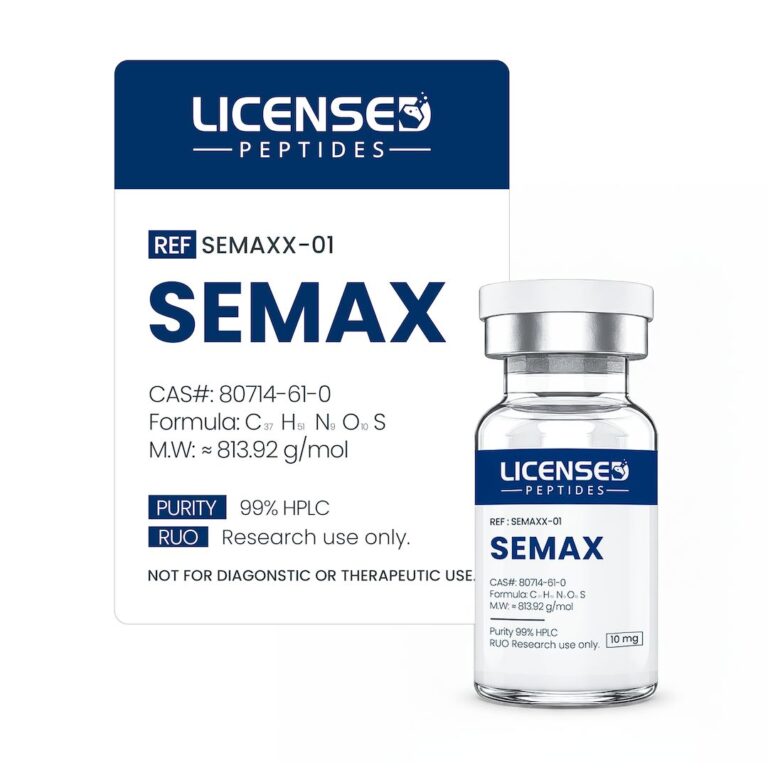
Semax is a synthetic heptapeptide with the following amino acid sequence:
Met–Glu–His–Phe–Pro–Gly–Pro.
The Institute of Molecular Genetics of the Russian Academy of Sciences (RAS) synthesized this peptide under the guidance of academicians I. P. Ashmarin and N. F. Myasoedov as part of the broader program of peptide bioregulators¹ – a state-funded decades-long initiative that wanted to use peptides to optimize biological functions.
The acetylated form of Semax is an analog of the adrenocorticotropic hormone (ACTH)(4–10) fragment. It is designed to retain biological activity while also remaining stable, so the peptide doesn’t break down as easily and stays active for longer.¹
The Structure and Classification of Semax
- Semax is a heptapeptide analog of ACTH(4–10).
- It’s made up of seven amino acids.¹
- Researchers have modified the peptide to improve its stability and lower the chances of degradation, eliminate the hormonal activity associated with ACTH itself, and retain its ability to interact with pathways involved in central nervous system signaling.
- Note: Unlike ACTH itself, Semax isn’t considered to be hormonally active.¹
- Researchers generally classify Semax as a nootropic-class peptide, which means it’s made up of amino acids that enhance cognitive activity. Existing studies currently examine how Semax is involved in cognitive function. This includes memory formation, neurochemical signaling, and cognitive enhancement pathways.²
Studied Mechanisms
Studies have explored how Semax affects brain-derived neurotrophic factor (BDNF). BDNF is a protein found in the areas of the brain associated with memory formation and learning, which helps brain cells grow. When it comes to learning something new or practicing a skill, BDNF aids with that.
A study published in the Journal of Neurochemistry found that, three hours after administration, Semax increased BDNF levels in the rat basal forebrain (the front part of a rat’s brain). Further observations found that BDNF levels also returned to baseline within 24 hours, which suggests that Semax may have a temporary effect on these pathways as opposed to causing lasting changes.²
In addition to this, researchers have also looked at how Semax interacts with dopamine and serotonin pathways, both of which influence motivation, attention, and how the brain processes information.¹˒²
It’s important to note that although these are interesting findings, they shouldn’t be interpreted as established human outcomes. Much of the available evidence has come from Russian preclinical studies and limited clinical investigations, which means there needs to be additional independent studies to understand the reproducibility and broader implications of these observations.
What Is Selank?

Selank is a synthetic heptapeptide with the following amino acid sequence:
Thr–Lys–Pro–Arg–Pro–Gly–Pro.
The peptide was developed from tuftsin, which is a naturally occurring immunomodulatory peptide involved in immune signaling (the communication between cells to stop threats to the body). Like Semax, it was developed at the Institute of Molecular Genetics of the Russian Academy of Sciences (RAS) as part of Russia’s peptide bioregulator research program.¹
However, unlike Semax, Selank research mostly revolves around stress-related signaling pathways and neurotransmitter regulation.
The Structure and Classification of Selank
- Selank is a heptapeptide, commonly classified as an anxiolytic-class peptide.
- However, it’s important to note that this classification reflects its studied mechanisms rather than any approved therapeutic role.
- Selank has been developed from tuftsin and modified. This improves stability and prolongs its metabolic half-life.²
Studied Mechanisms
One study published in the journal Frontiers in Pharmacology discovered that Selank altered expression patterns in 45 of 84 neurotransmission-related genes one hour after it had been administered, with changes in 22 genes still observed three hours later.³
Many of these genes are involved in GABA signaling, which helps regulate how nerve cells communicate with each other in the brain. This maintains balanced activity.
Furthermore, researchers are interested in Selank because it may potentially influence serotonin-related gene expression and pathways, which contribute to regulating emotions and mental resilience.³˒⁴
Important to Note: Selank has been evaluated in some clinical human trials, but most research regarding this peptide comes from preclinical studies and investigations involving animal models. Global regulatory bodies like the FDA don’t approve its use for human consumption, which is why there needs to be more research to truly understand the effect on humans.
Semax vs Selank Peptides: The Important Differences at a Glance
Selank and Semax may share the same origins, but researchers are interested in studying the two peptides along different pathways and for different goals. The following side-by-side comparison talks about the main characteristics of these peptides:
| Semax | Selank | |
| Peptide Source/Derivation | Synthetic analog of ACTH(4–10) | Synthetic peptide derived from tuftsin |
| Amino Acid Sequence Length | Seven amino acids: Met–Glu–His–Phe–Pro–Gly–Pro. | Seven amino acids: Thr–Lys–Pro–Arg–Pro–Gly–Pro. |
| Primary Research Classification | Nootropic-class peptide | Anxiolytic-class peptide |
| Primary Studied Pathway | BDNF expression, dopamine, and serotonin signaling | GABA-A receptor system, serotonin-related gene expression |
Peptides With a Shared Origin But Divergent Research Focus
As we’ve already discussed, Selank and Semax peptides came from the same Russian peptide development program. Despite that, they are two very different peptides with different biological pathways under investigation.
The clearest distinction between the two is often:
- Semax: BDNF-pathway research
- Selank: GABA-pathway research
Some medical publications examine both Semax and Selank within the same framework. This is because the two peptides may provide complementary information about cognitive performance and stress-related signaling.
However, research that combines both peptides is currently limited.
Considerations for Selecting High-Quality Selank and Semax Peptides
If you’re a researcher who is evaluating peptide vendors, ensure to pay close attention to analytical documentation. Even the smallest of differences between batches can introduce variables that make research findings harder to interpret.
Purity Standards
A quality benchmark frequently cited within Selank and Semax peptide manufacturing is 99%+ purity. Each batch should be third-party tested and have a Certificate of Analysis (COA). Researchers should verify that purity reports correspond to the exact batch under review.
What to Look for in a Certificate of Analysis (COA)
A COA should match the exact batch you’re reviewing and include:
- Purity results of 99% or higher
- Batch number and testing date
- High-performance liquid chromatography (HPLC) data
- Endotoxin, heavy metal, and lipopolysaccharide (LPS) screening
- Testing methods or third-party verification details
At Licensed Peptides, we publish documentation for every batch of Semax 30 mg and Selank 10 mg. All our peptides undergo third-party testing verification, and COAs are available for verification.
To compare analytical documentation across products, explore our research peptides.
Storage and Handling
Degradation is always a concern when working with peptides, both at a chemical and physical level. Due to this, researchers should store peptides such as lyophilized Semax and Selank peptides under refrigerated or frozen conditions to protect them from exposure to moisture and light.
We also recommend recording the reconstitution date and keeping handling practices consistent, as this will help reduce variability between experiments.
Important: Peptides may have different storage and preparation requirements. Researchers should review the documentation given by the supplier before beginning an experiment.
Compliance, Legality, and Responsible Research Use of Semax and Selank
Under US law, neither Semax nor Selank has been approved by the FDA as a pharmaceutical product or recognized as a dietary supplement. Both compounds are sold strictly as research peptides for analytical and research applications.
However, it’s also worth noting that regulatory treatment differs internationally. Researchers are responsible for understanding and complying with laws in their own jurisdiction before they obtain or study these materials.
FAQs
What Is the Main Difference Between Semax and Selank?
The main difference between Semax and Selank is their function. For example, research for Semax is mainly focused on BDNF-related pathways, which are the communication networks in the brain that control neuroplasticity. This affects the brain’s ability to heal, as well as grow and learn new things. Semax is also related to dopamine and serotonin signaling.
In comparison, Selank research focuses on GABA-related signaling and serotonin-associated gene expression and is studied in regard to its response to anxiety.
Researchers have been studying brain function, emotional resilience, and stress-related signaling in animal models for both of these compounds.
Where Do Semax and Selank Come From?
Both Semax and Selank were developed in Russia, at the Institute of Molecular Genetics, as part of their peptide bioregulator research initiative. Semax was designed from an ACTH fragment, while Selank was derived from tuftsin, which is a naturally occurring peptide involved in immune system activity.
Are Semax and Selank Studied Together in Research Protocols?
Some studies talk about Semax and Selank within the same experimental framework. Semax and Selank tend to go hand in hand because researchers are interested in how both may influence complementary pathways.
Clinical research on both peptides is still limited, especially when it comes to using them together.
Are Semax and Selank Research Peptides?
Yes, Semax and Selank are both research peptides under US law, which are different from peptides that are approved for human consumption. A research peptide is only intended for use within the laboratory for analytical purposes and scientific applications. It’s not considered a dietary supplement or an approved medicine in the United States.
However, Semax and Selank are approved prescription medications in other parts of the world. For example, they are currently approved in Russia.
How Does Semax’s Studied Mechanism Differ From Selank’s?
When it comes to Semax research, scientists are interested in pathways associated with mental performance, such as memory consolidation, as well as cognitive enhancement.
In comparison, research regarding Selank focuses more heavily on GABA signaling and pathways associated with emotional stability. Researchers have not confirmed these effects in humans.³˒⁴
What Should a Selank or Semax Peptide COA Include?
A peptide COA stands for Certificate of Analysis, a formal document issued by an independent, third-party laboratory. The COA verifies the purity and identity of a specific batch of a peptide to ensure it’s a high-quality choice for research.
Any peptide’s COA should match the batch being evaluated exactly and include the following information:
- Purity results
- Testing dates
- Batch numbers
- Chromatographic data, such as HPLC results
Other important aspects we recommend researchers review include endotoxin, heavy metal, and lipopolysaccharide (LPS) screening, along with details about testing methods or third-party verification.
At Licensed Peptides, all our research peptides come with a COA, so researchers know they’re getting the best quality batches.
Why Does Purity Percentage Matter for Research Validity?
Even small differences in purity can introduce variables that affect the reproducibility of scientific research. Lower-purity samples may make it more difficult to compare results across studies or evaluate biological pathways. That’s why it’s important for researchers to obtain their peptides from trusted sources that are transparent about the purity and the quality of their peptides.
Are Semax and Selank Legal to Purchase in the U.S.?
Companies may sell Semax and Selank for research purposes in the United States. But neither compound is approved by the FDA as a pharmaceutical product nor recognized as a dietary supplement that’s fit for human consumption.
Conclusion
The biggest difference regarding Selank vs Semax comes down to pathway focus. The main focus of Semax research is BDNF expression, monoamine signaling, and cognitive-pathway investigations, whereas Selank research concentrates on GABA-A receptor activity, serotonin-related gene expression, and stress-pathway signaling.
Although researchers have explored both peptides in animal models and early clinical investigations, they have not confirmed these findings in humans under US law. Independent studies will help clarify the consistency and broader implications of the available data.
References
- Deigin VI, Poluektova EA, Beniashvili AG, Kozin SA, Poluektov YM. Development of peptide biopharmaceuticals in Russia. Pharmaceutics. 2022;14(4):716.
- Dolotov OV, Inozemtseva LS, Zolotarev YA, et al. Semax, an analogue of adrenocorticotropin (4–10), binds specifically and increases levels of brain-derived neurotrophic factor protein in rat basal forebrain. J Neurochem. 2006;97(suppl 1):82-86.
- Volkova IV, Shadrina MI, Kolomin TA, et al. Selank administration affects the expression of some genes involved in GABAergic neurotransmission. Front Pharmacol. 2016;7:31.
- Filatova E, Kasian A, Kolomin T, et al. GABA, Selank, and olanzapine affect the expression of genes involved in GABAergic neurotransmission in IMR-32 cells. Front Pharmacol. 2017;8:89.

