GHK-Cu: copper(II) coordination chemistry of the Gly-His-Lys tripeptide, a published study summary
Summary
This summary brings together three chemistry papers on the copper(II) complex of the tripeptide Gly-His-Lys (GHK). Hureau and colleagues (Chemistry, A European Journal, 2011) determined X-ray and solution structures of Cu(II)-GHK and examined its redox behaviour. Trapaidze and colleagues (Journal of Biological Inorganic Chemistry, 2012) measured the thermodynamics of Cu(II) binding by isothermal titration calorimetry. Beuning and colleagues (Inorganic Chemistry, 2018) measured the rate at which Cu(II) is exchanged between GHK and a fluorescent analogue. The endpoints are coordination geometry, dissociation constant, enthalpy and entropy of binding, redox potential and exchange rate constants.
Peptide
- Name
- GHK-Cu (copper(II) complex of glycyl-L-histidyl-L-lysine)
- Sequence
- Gly-His-Lys
- CAS
- 49557-75-7 for the copper complex; 72957-37-0 for the free tripeptide
- Formula
- C14H22CuN6O4, approximately 403.9 g/mol for the complex; C14H24N6O4, approximately 340.4 g/mol for the free tripeptide
- Class
- Tripeptide copper(II) chelate. The authors describe GHK as a naturally occurring copper-binding motif found in human plasma.
Study design
Hureau 2011: Cu(II)-GHK and Cu(II)-DAHK (Asp-Ala-His-Lys) were studied in the solid state and in solution. Techniques were single-crystal X-ray diffraction, electron paramagnetic resonance (EPR), hyperfine sub-level correlation spectroscopy (HYSCORE), X-ray absorption spectroscopy, and proton and carbon-13 NMR. Ternary complexes of Cu(II)-GHK with glycine or histidine were examined. Redox behaviour was studied by cyclic voltammetry and by following ascorbate oxidation in the presence of molecular oxygen.
Trapaidze 2012: isothermal titration calorimetry (ITC) of Cu(II) binding to GHK and DAHK at pH 7.4, using glycine as a weaker competing ligand so that the high-affinity binding could be quantified. Experiments were repeated in different buffers to count the protons released on binding and to separate the buffer contribution.
Beuning 2018: interpeptidic Cu(II) exchange from Cu(H-1GHW), in which the lysine of GHK is replaced by tryptophan, to GHK and DAHK, measured by static fluorescence quenching of the tryptophan residue.
Reported findings
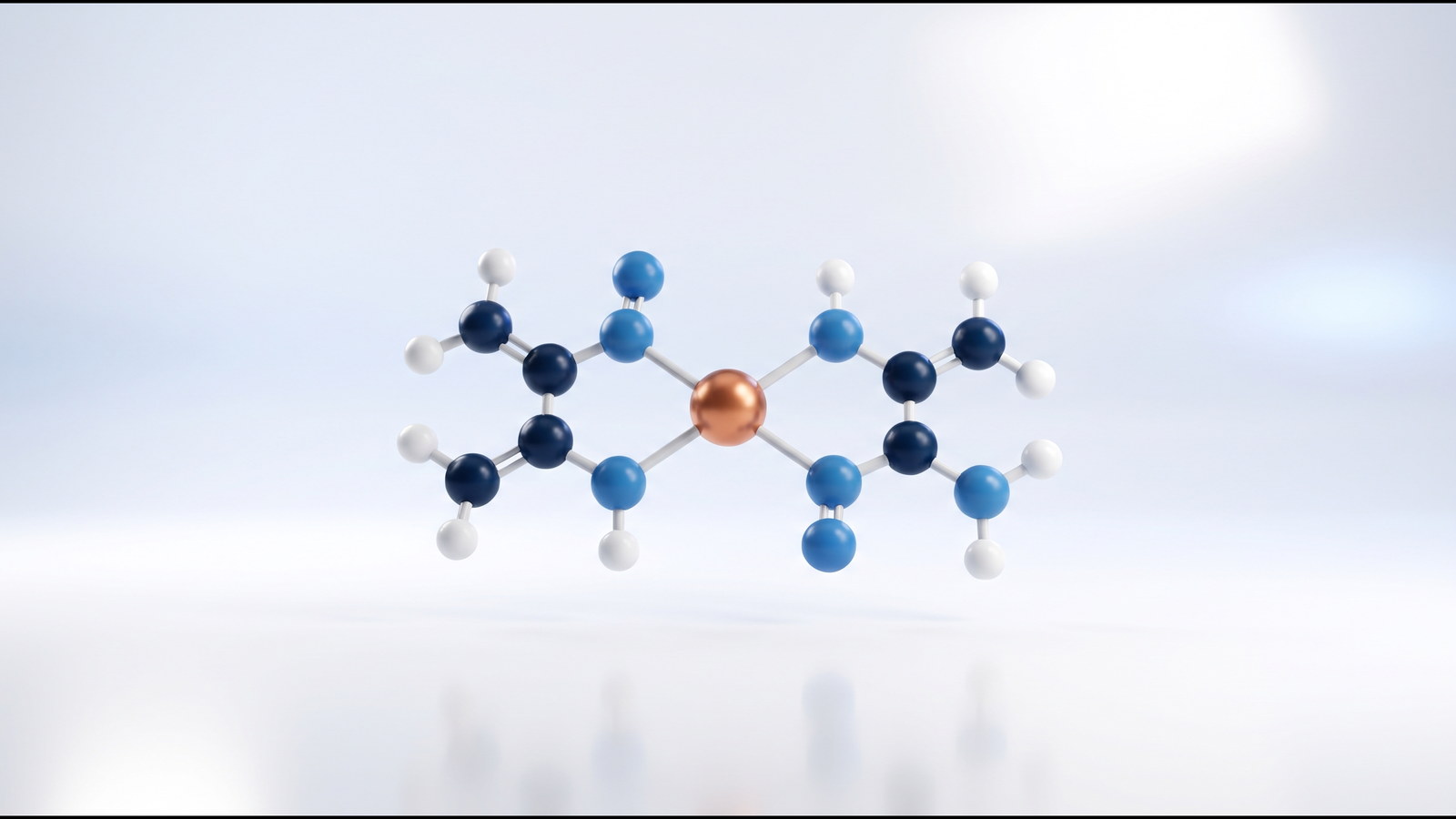
Hureau and colleagues reported that Cu(II)-GHK is dimeric in the solid state but forms a monomeric complex in solution with three nitrogen donors: the terminal amine, an amidyl nitrogen and the imidazole nitrogen of histidine. In the solid state the fourth equatorial site was occupied by a labile oxygen atom from a carboxylate. The Cu(II) exchange between GHK peptides was fast, which the authors attributed to a Cu(II)(GHK)2 species, whereas exchange between DAHK peptides was very slow. Both complexes were reported as inert under moderate redox potentials. Cu(II)-GHK could be reduced to Cu(I) at about -0.62 V versus AgCl/Ag, with subsequent release of the copper ion; Cu(II)-DAHK did not show this behaviour.
Trapaidze and colleagues reported 1:1 binding stoichiometry for both peptides. The conditional dissociation constants at pH 7.4, corrected for the glycine competitor and the buffer, were 7.0 plus or minus 1.0 x 10⁻¹⁴ M for GHK and 2.6 plus or minus 0.4 x 10⁻¹⁴ M for DAHK. The entropic and enthalpic contributions differed between the two peptides, with an enthalpic contribution reported for GHK. The authors stated that the values agreed with literature values obtained by other techniques.
Beuning and colleagues reported apparent second-order rate constants for Cu(II) transfer from Cu(H-1GHW) of 1.6 plus or minus 0.2 x 10² M-1 s-1 to GHK and 5.0 plus or minus 0.7 x 101 M-1 s-1 to DAHK.
An earlier potentiometric and spectroscopic study by Conato and colleagues (2001) reported that the lysine side-chain amino group takes part in complex formation only at alkaline pH and remains protonated at physiological pH.
Limitations
These are physical-chemistry measurements on purified peptide and copper salts in buffer or in the crystalline state. The dissociation constants are conditional values at pH 7.4 and depend on the competitor model used. No cell, animal or human data are summarised here.
References
- Hureau C, Eury H, Guillot R, Bijani C, Sayen S, Solari PL, Guillon E, Faller P, Dorlet P. Chemistry, A European Journal. 2011;17(36):10151-10160. PMID 21780203. DOI 10.1002/chem.201100751.
- Trapaidze A, Hureau C, Bal W, Winterhalter M, Faller P. Journal of Biological Inorganic Chemistry. 2012;17(1):37-47. PMID 21898044. DOI 10.1007/s00775-011-0824-5.
- Beuning CN, Mestre-Voegtle B, Faller P, Hureau C, Crans DC. Inorganic Chemistry. 2018;57(9):4791-4794. PMID 29648796. DOI 10.1021/acs.inorgchem.8b00182.
- Conato C, Gavioli R, Guerrini R, Kozlowski H, Mlynarz P, Pasti C, Pulidori F, Remelli M. Biochimica et Biophysica Acta. 2001;1526(2):199-210. PMID 11325542. DOI 10.1016/s0304-4165(01)00127-1.
This summary describes published research for the information of qualified researchers. It is not a description of any product sold on this site, which are supplied for in-vitro laboratory research only and are not for human or veterinary use.