LL-37: solution conformation by circular dichroism and membrane orientation by ATR-FTIR, a published study summary

Summary
This summary covers two structural studies of the 37-residue human peptide LL-37 and one microbiological characterisation. Johansson and colleagues (Journal of Biological Chemistry, 1998) used circular dichroism to follow how ion composition, pH and peptide concentration change the conformation of LL-37 in solution and related the helical content to activity against bacteria. Oren and colleagues (Biochemical Journal, 1999) examined oligomerisation, proteolytic stability and the orientation of the peptide on model lipid membranes by polarised attenuated total reflectance Fourier-transform infrared spectroscopy (ATR-FTIR). Turner and colleagues (Antimicrobial Agents and Chemotherapy, 1998) measured minimal inhibitory concentrations against a panel of organisms and binding to lipopolysaccharide.
Peptide
- Name
- LL-37
- Sequence
- Leu-Leu-Gly-Asp-Phe-Phe-Arg-Lys-Ser-Lys-Glu-Lys-Ile-Gly-Lys-Glu-Phe-Lys-Arg-Ile-Val-Gln-Arg-Ile-Lys-Asp-Phe-Leu-Arg-Asn-Leu-Val-Pro-Arg-Thr-Glu-Ser (LLGDFFRKSKEKIGKEFKRIVQRIKDFLRNLVPRTES)
- CAS
- 154947-66-7
- Formula
- C205H340N60O53, approximately 4493 g/mol
- Class
- Cathelicidin family; the C-terminal 37 residues of the human precursor protein hCAP18.
Study design
Johansson 1998: synthetic LL-37 and two N-terminally shortened homologues, FF-33 and SK-29 (4- and 8-residue deletions), examined by circular dichroism in water and in solutions of defined anion composition (bicarbonate, sulfate, trifluoroacetate and chloride), across a range of pH values and peptide concentrations. Antibacterial activity was measured against Gram-positive and Gram-negative strains, including Escherichia coli D21, and cytotoxicity was measured against several eukaryotic cell lines. The effect of human serum on both activities was tested.
Oren 1999: synthetic LL-37, its truncated form FF-33 and fluorescent derivatives were characterised for monomer-oligomer equilibrium in solution, resistance to proteolytic degradation in solution and when bound to zwitterionic or negatively charged model membranes, haemolytic activity, and secondary structure and orientation on zwitterionic lipid membranes by polarised ATR-FTIR.
Turner 1998: radial diffusion assays and a standardised (NCCLS-type) broth microdilution assay in low-salt and 100 mM NaCl media; membrane permeabilisation of E. coli ML-35p; binding to E. coli O111:B4 lipopolysaccharide by chromogenic Limulus assay; circular dichroism in the presence of lipid A.
Reported findings
Johansson and colleagues reported that at micromolar concentration in water LL-37 gives a circular dichroism spectrum consistent with a disordered structure. Addition of 15 mM bicarbonate, sulfate or trifluoroacetate caused the peptide to adopt a helical structure with approximately equal efficiency, while 160 mM chloride was less efficient. A cooperative transition from disordered to helical structure was observed as peptide concentration increased, consistent with oligomer formation. The extent of alpha-helicity correlated with antibacterial activity. FF-33 and SK-29 required higher anion concentrations for helix formation and were less active than LL-37 against E. coli D21. Below pH 5 the helical content decreased gradually and at pH 2 the peptide was entirely disordered, whereas the helical structure was retained above pH 13. The minimal inhibitory concentration against E. coli was 5 micromolar, and at 13 to 25 micromolar the peptide was cytotoxic to several eukaryotic cell lines. In the presence of human serum both the antibacterial and the cytotoxic activities were inhibited.
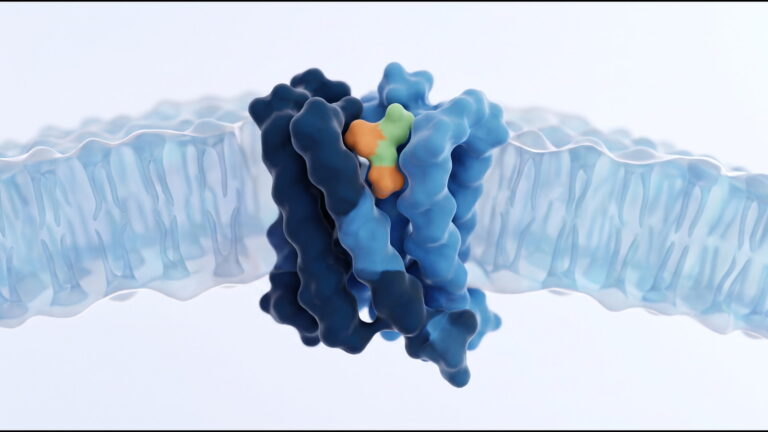
Oren and colleagues reported that LL-37 exists in equilibrium between monomers and oligomers in solution at very low concentrations and is significantly resistant to proteolytic degradation both in solution and when bound to either membrane type. The N-terminus was reported to contribute to proteolytic resistance and haemolytic activity but not to antibacterial activity. Polarised ATR-FTIR showed the peptide to be predominantly alpha-helical and oriented nearly parallel with the surface of zwitterionic lipid membranes, which the authors took as evidence for a detergent-like, carpet mechanism rather than a transmembrane pore.
Turner and colleagues reported minimal inhibitory concentrations below 10 micrograms per millilitre against Pseudomonas aeruginosa, Salmonella typhimurium, E. coli, Listeria monocytogenes, Staphylococcus epidermidis, Staphylococcus aureus and vancomycin-resistant enterococci, including in media containing 100 mM NaCl; certain organisms were susceptible only in low-salt media, and Burkholderia cepacia was resistant in both. LL-37 permeabilised the outer and inner membranes of E. coli ML-35p and bound lipopolysaccharide with positive cooperativity (Hill coefficient 2.02). Circular dichroism showed a transition from random coil to alpha-helix in the presence of lipid A.
Limitations
These are biophysical and microbiological measurements on synthetic peptide in buffer, on model membranes and in culture media. Activity values depend on the assay medium and salt concentration, as the 1998 papers themselves show. No animal or human data are summarised here.
References
- Johansson J, Gudmundsson GH, Rottenberg ME, Berndt KD, Agerberth B. Journal of Biological Chemistry. 1998;273(6):3718-3724. PMID 9452503. DOI 10.1074/jbc.273.6.3718.
- Oren Z, Lerman JC, Gudmundsson GH, Agerberth B, Shai Y. Biochemical Journal. 1999;341(Pt 3):501-513. PMID 10417311.
- Turner J, Cho Y, Dinh NN, Waring AJ, Lehrer RI. Antimicrobial Agents and Chemotherapy. 1998;42(9):2206-2214. PMID 9736536. DOI 10.1128/AAC.42.9.2206.
This summary describes published research for the information of qualified researchers. It is not a description of any product sold on this site, which are supplied for in-vitro laboratory research only and are not for human or veterinary use.