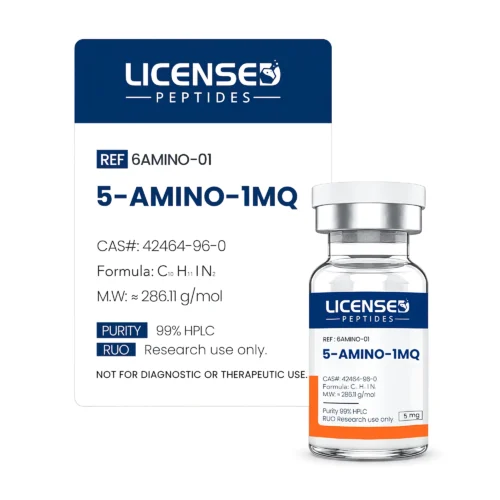
What Is 5-Amino-1MQ?
5-Amino-1MQ is a common abbreviation for 5-amino-1-methylquinolinium. It’s a small-molecule research compound investigated in studies involving Nicotinamide N-Methyltransferase (NNMT). Unlike peptides, 5-Amino-1MQ belongs to the methylquinolinium class of compounds. It’s studied as a selective NNMT inhibitor in laboratory settings.
NNMT is an enzyme that catalyzes the transfer of a methyl group from S-adenosylmethionine (SAM) to nicotinamide (NAM), producing 1-methylnicotinamide (MNA) and S-adenosylhomocysteine (SAH). NNMT participates in nicotinamide metabolism through this activity. It may influence cellular methylation balance, metabolic signaling, and NAD⁺-related biochemical pathways.
Why Researchers Study 5-Amino-1MQ
Scientific interest in 5-Amino-1MQ comes from the research into NNMT biology and its contribution to cellular metabolism.
Published studies have investigated NNMT and NNMT inhibitors across areas of laboratory and preclinical research, including
- Nicotinamide metabolism
- NNMT pathway regulation
- Cellular energy metabolism
- NAD+ salvage-pathway biology
- Adipocyte biology
- Molecular signaling pathways
- Methylation-related biochemical processes
- Experimental metabolic research models
NNMT influences multiple interconnected biochemical pathways. Researchers investigate how selective NNMT inhibition affects cellular processes under controlled laboratory conditions.
Key Published Research
A widely cited study by Kraus and colleagues used genetic knockdown in mice. They investigated the biological role of NNMT. The researchers reported that lowering NNMT expression changed metabolic pathway activity and energy use. This helped to show that NNMT is a key target in metabolic research.¹
Neelakantan and colleagues then expanded research involving small-molecule NNMT inhibitors. Their work found and described several selective NNMT inhibitors, including 5-amino-1-methylquinolinium derivatives. They tested these inhibitors in cell and animal models.² They reported changes in intracellular nicotinamide-related metabolites and examined the biological effects of NNMT inhibition under experimental conditions.²
These outcomes have increased scientific interest in NNMT biology. They still support lab studies on its role in cell metabolism. They also support research on biochemical regulation.
Research Considerations And Limitations
Current evidence involving 5-Amino-1MQ and NNMT inhibition is predominantly preclinical. Most published findings originate from cell-based studies and animal models.
Although NNMT may affect nicotinamide levels and NAD+ pathways, the real impact in the body is still unclear. Research is ongoing. Changes in NNMT activity shouldn’t be interpreted as producing predictable changes in NAD+ levels across all biological systems.
Human safety, efficacy, dosing, and clinical utility haven’t been established. Further research is required to characterize the biological mechanisms associated with NNMT inhibition and the broader implications of these findings.
Licensed Peptides supplies 5-Amino-1MQ strictly for laboratory research purposes. It isn’t approved for human or animal use.
References
- Kraus D, Yang Q, Kong D, et al. Nicotinamide N-methyltransferase knockdown protects against diet-induced obesity. Nature. 2014;508(7495):258-262. doi:10.1038/nature13198.
- Neelakantan H, Vance V, Wetzel MD, et al. Selective and membrane-permeable small molecule inhibitors of nicotinamide N-methyltransferase reverse high fat diet-induced obesity in mice. Biochemical Pharmacology. 2018;147:141-152.
- Aksoy S, Szumlanski CL, Weinshilboum RM. Human nicotinamide N-methyltransferase. Pharmacogenetics. 1994;4(2):81-86.
- Alston TA, Abeles RH. Substrate specificity and catalytic mechanism of nicotinamide N-methyltransferase. Archives of Biochemistry and Biophysics. 1988;260(2):601-608.
- Gao Y, Martin NI, van Haren MJ. Nicotinamide N-Methyltransferase: At the crossroads of metabolism and epigenetic regulation. Trends in Biochemical Sciences. 2024.
Important Notice
This product is supplied strictly for research use only. It is not approved or intended for human or animal use, consumption, therapeutic use, clinical application, or diagnostic purposes. Any discussion of biological activity refers solely to laboratory, in vitro, or preclinical research.